

Table of Contents
- Production Runs and Manufacturing Costs Behind Diecast Prices
- Key Factors Affecting Diecast Model Prices
- Licensing Fees, Inflation, and Raw Material Costs
- Secondary Market Scarcity and Collector Market Demand
- How to Value Vintage Diecast Cars and Assess Diecast Car Investment Value
- Craftsmanship, Detail Level, and Technological Advancements
- Frequently Asked Questions
Last Updated: September 11, 2026
Production Runs and Manufacturing Costs Behind Diecast Prices
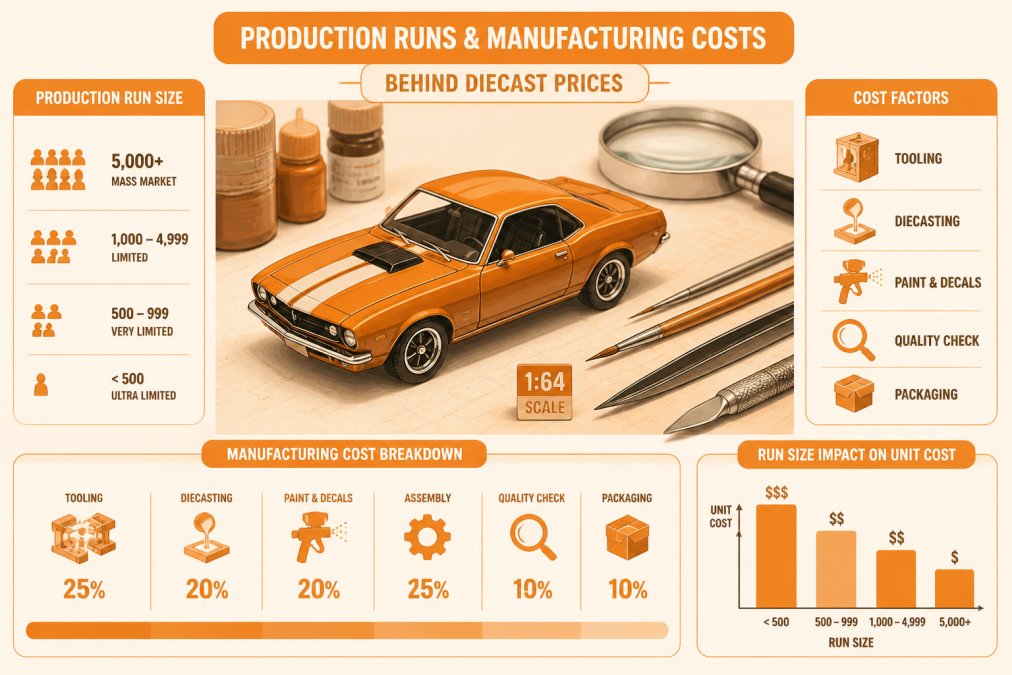
Collectible diecast prices are higher because the cost of making a model car is front-loaded, spread across a limited number of units, and paid before the first car ships. The gap between a $2 mainline Hot Wheels and a $50 numbered Red Line Club car is mold tooling, paint, licensing, and scarcity.
Diecast manufacturing is capital-intensive: a single casting requires precision steel tooling, a cost fixed whether you produce 3,000 cars or 3 million.
Mold Tooling and Paint Finish Expenses
Mold tooling is the single largest upfront cost in diecast manufacturing. A die-cast mold is cut from hardened steel and must hold tolerances fine enough to reproduce door lines, hood gaps, and grille slats at 1:64 scale. It is expensive to cut and wears out, so it must be amortized across the production run, a short run spreads the same cost over fewer cars.
Paint finish adds a second layer. Standard castings use simple sprayed enamel; premium releases use multi-stage finishes like Spectraflame, chrome plating, or two-tone liveries requiring masking, curing, and quality checks. Every extra pass through the paint booth adds labor, rejects, and time.
How Limited Production Runs Drive Scarcity
Limited production runs drive scarcity by design. When a manufacturer caps a release at a fixed number, that number becomes the total supply forever, no reprint, no restock, no second wave. A run of 3,000 units for a global collector base means most collectors will never own one at retail.
The childrenstoycloset.com product catalog reflects this directly. The Hot Wheels RLC Custom Plymouth Barracuda in chrome is numbered out of 3,000 units worldwide, and the Hot Wheels RLC Redline Club Real Riders Series 5 '67 Camaro is capped at 11,000 pieces, numbers set by tooling amortization, licensing terms, and expected demand.

Key Factors Affecting Diecast Model Prices
The factors affecting diecast model prices come down to four variables: material, scale, detail level, and production volume. Change any one and the retail price moves.
Material matters first. Metal casting gives a diecast model its weight, cold-to-the-touch feel, and ability to hold fine panel gaps. Plastic-bodied models cost less but feel hollow and rarely command collector premiums, a difference in manufacturing method and material cost, not snobbery.
Scale matters second. A 1:64 scale car uses a fraction of the metal, paint, and packaging of a 1:18 model, and larger scales require more complex assembly, more separately molded parts, and sturdier boxes.
Material Quality: Metal Casting vs. Plastic
Diecast refers to a process where molten metal alloy is poured into a steel mold under pressure, producing a part with sharp detail and consistent dimensions, a model with genuine heft and a surface that takes paint and chrome finishes well.
Metal casting costs more per unit than injection-molded plastic, but it is the only way to achieve the weight and detail collectors associate with premium models. Interior detailing, opening panels, and rubber tires add cost on top of the base casting.
Scale and Size Influence on Pricing
Scale and size influence pricing because material volume scales non-linearly with dimensions. Doubling a model's size multiplies metal use by roughly eight, since volume scales with the cube of length (mathworld.wolfram.com). A 1:18 car uses far more alloy than a 1:64 car of the same subject.
Scale |
Typical Use |
Material Volume |
Collector Price Band |
|---|---|---|---|
1:64 |
Mainline and premium releases |
Lowest |
Entry to mid |
1:24 |
Display and gift models |
Moderate |
Mid |
1:18 |
Showpiece collectibles |
Highest |
Premium |
Licensing Fees, Inflation, and Raw Material Costs
Licensing fees are the hidden cost most collectors never see on the box, and the biggest reason two visually similar cars can sit $20 apart on the same shelf. Every officially branded car, an automaker nameplate, film franchise livery, or motorsport team's colors, requires a license negotiated per property, per term, and often per unit sold.
Licensing is a tiered system, and the tier a model falls into shapes its retail price before a single casting is poured.
- Automaker nameplates (Ferrari, Porsche, Lamborghini, etc.): These are premium licenses. The rights holder approves the design, controls how the badge is used, and typically takes a royalty on wholesale or retail revenue. A single-brand license can add several dollars to the cost of a 1:64 car that would otherwise retail for a few dollars.
- Film and entertainment properties (Fast and Furious, Disney Cars, Batman): These licenses are often the most expensive because the rights holder is protecting a global brand. Terms are usually shorter, approvals are stricter, and the licensor may require minimum production volumes or marketing commitments.
- Motorsport and racing liveries (NASCAR, Formula 1, Le Mans teams): These sit between the two. The team or series owns the livery, the sponsor owns the logos, and both may need to sign off. That is why a race-liveried car can cost more than the same casting in a plain color.
- Generic or in-house castings: No license, no royalty, no approval cycle. This is why a plain hot rod or fantasy casting can be sold at pocket-money prices while a licensed version of the same tooling sells for multiples more.
Inflation and raw material costs compound the problem. Zinc alloy, the base metal in most diecast models, tracks commodity markets, so when zinc, aluminum, and copper prices rise, so does the cost of every casting (usgs.gov). Add higher freight, packaging, and labor, and the same mold that produced a $5 car a decade ago now costs noticeably more to make.
Three cost lines have moved in ways that specifically hit diecast:
- Zinc and aluminum. Both trade on global commodity exchanges and saw sharp spikes and sustained elevation during the post-pandemic industrial recovery. Diecast manufacturers buy alloy in bulk, so a sustained metal price move shows up in wholesale casting costs within a few production cycles.
- Ocean freight. Most diecast production is concentrated in a few Asian factories, and finished models ship worldwide. Container rates swung from historic lows to historic highs and back in a short window; long-term contracts absorbed some of that, but not all (unctad.org). Freight is a per-unit cost that lands on every car in the container.
- Labor and energy. Factory wages in producing regions have risen steadily, and energy costs affect both casting and painting. Paint booths and curing ovens are energy-intensive, so a premium multi-stage finish carries a higher energy cost than simple sprayed enamel.
The net effect is that the floor on what a diecast model costs to make has risen across the board. A mainline car that retailed for a dollar or two a generation ago now retails for several times that, and a meaningful share of the increase is metal, freight, and labor, not margin.
For collectors, licensing and input costs are structural, not temporary, they will not reverse when a single commodity dips. The models that hold value are those where the price reflects genuine scarcity and build quality, not just a licensed logo on the box.
Secondary Market Scarcity and Collector Market Demand
Secondary market scarcity and collector market demand set the real price of anything sold out at retail. Once a limited edition sells through, the only supply is whatever existing owners will sell, that is where price discovery happens.
Market demand is not evenly distributed. A completed set commands more than the sum of its parts, because collectors chasing a full series pay a premium for the final missing piece. Series like Acceleracers and Fast and Furious create exactly this dynamic: collectors who started a set years ago are still hunting the gaps, and the supply of those gaps does not grow.
Retail price and market price are two different numbers: retail is set by the manufacturer, while market price is set by whoever holds the last available unit.
How to Value Vintage Diecast Cars and Assess Diecast Car Investment Value
Valuing vintage diecast cars comes down to four checks: production numbers, condition, completeness, and demand for the specific casting. A scarce car in poor condition can be worth less than a common car in mint condition, so no single factor decides value alone.
Diecast car investment value is the market price a specific model can realistically command when sold, based on verified sales rather than asking prices. Asking prices are noise. Sold prices are signal.
Grading and Condition Impact on Resale Value
Grading and condition impact resale value more than almost any other variable. A factory-sealed model in original packaging will always outperform an identical model that has been opened, handled, or displayed. Paint chips, bent axles, and worn tampo graphics all reduce value, and once a blister pack is opened, it cannot be un-opened.
Use this checklist when assessing a model's condition before you buy or sell:
- Is the packaging factory-sealed and unopened?
- Is the blister or box free of cracks, dents, and sun fading?
- Is the paint finish free of chips, scuffs, and orange peel?
- Are the wheels straight and the axles unbent?
- Are the tampo graphics sharp, with no silvering or misalignment?
- Is the model individually numbered, if the release was numbered?
- Can you find recent sold listings for the same casting and condition?
Craftsmanship, Detail Level, and Technological Advancements
Craftsmanship and detail level separate a toy from a collectible. The difference shows in things a casual buyer might miss: separately molded headlights, photo-etched badges, accurate wheel profiles, and interiors with visible dashboard detail. Each is an extra mold, an extra assembly step, and an extra cost.
What most price explanations miss is that the technology used to design and tool a diecast model has changed more in the last twenty years than in the fifty before it, and that change pushed costs up, not down.
From hand-carved masters to 3D scanning
Older diecast models were developed from hand-carved or hand-machined masters. A skilled patternmaker shaped a master, and tooling was cut from it. The process was slow and craft-dependent, but the tooling was relatively inexpensive because it derived from a physical object rather than a full digital model.
Modern premium diecast starts with a digital model. Manufacturers use 3D scanning to capture a real vehicle, often a privately owned car or museum example, at high resolution, then clean it up in CAD software, define panel gaps, and engineer it for moldability before tooling is cut.
That workflow adds cost at every stage:
- Scanning and data capture. Access to the real vehicle, scanning equipment, and labor to process the point cloud into usable geometry.
- CAD engineering. Designers model the exterior, interior, chassis, wheels, and every separately molded part. A premium 1:18 model can have hundreds of components, each needing its own tooling.
- Tooling complexity. Finer detail means more tooling inserts, tighter tolerances, and more expensive steel work. A simple mainline mold is a fraction of the cost of a multi-part premium mold.
- Prototyping and approval. Licensed models must be approved by the rights holder, often requiring multiple physical prototypes, revisions, and sign-offs before production.
Why better technology did not make models cheaper
It is reasonable to assume better technology lowers prices, but in diecast the opposite happened for premium releases. CAD and 3D scanning raised the ceiling on what a model can look like, and collectors rewarded that detail. Manufacturers competed on fidelity rather than price, investing in more complex tooling, more parts, and more finishing steps.
At the same time, the low end got cheaper in real terms. A basic mainline casting is produced in enormous volumes with simple tooling and minimal assembly, benefiting from scale. The gap between a mainline car and a premium collector release has widened because the premium end absorbed the new technology while the mainline end optimized for volume.
Digital printing is a good example. Older pad-printing applied tampo graphics with a physical pad, limiting livery fineness and producing a certain reject rate. Modern digital printing applies sharper graphics with more precision and fewer rejects, but the equipment and setup cost more, better-looking models at a higher production cost per unit, a trade-off collectors have largely accepted.
What this means for collectors
Technological advancement in diecast is not a cost-saving story but a quality-escalation story. Each generation of premium models is more detailed and costs more to produce, which is why a modern premium release can retail for several times what an equivalent model cost twenty years ago even after adjusting for inflation.
The practical implication is that detail is verifiable. Separately molded headlights, photo-etched badges, accurate wheel profiles, and crisp tampo graphics are physical evidence of the tooling and finishing investment behind a model. Comparing two similar cars, the one with more separately molded parts and sharper graphics almost always cost more to make, a real signal of where it sits in the market.
Frequently Asked Questions
Will diecast cars go up in value?
Some diecast cars appreciate, but it depends on rarity, condition, and demand. Limited edition models with low production runs, like a numbered Hot Wheels RLC release, often increase in value over time. However, mass-produced mainline cars rarely appreciate. The diecast car investment value is strongest for factory-sealed, low-production items from sought-after series such as Acceleracers or Fast and Furious. Market trends and collector interest ultimately determine whether a specific model goes up in value.
What factors make a diecast car rare or valuable?
Rarity comes from limited production runs, exclusive distribution, and high demand. Factors affecting diecast model prices include mold tooling costs, licensing fees, material quality (metal vs. plastic), scale (1:18, 1:24, 1:64), and paint finish. Condition and grading also matter greatly. A factory-sealed model with a pristine box commands a premium. Additionally, vintage models from the 1960s or 1970s with original packaging are highly sought after by collectors.
How does production volume affect diecast pricing?
Lower production volume directly increases scarcity. When a manufacturer produces only 3,000 units worldwide, as with some Hot Wheels RLC releases, each piece becomes more desirable. High production runs of mainline cars keep prices low. Limited edition diecast cars often sell out quickly and then appreciate on the secondary market. Collectors pay more for exclusivity, so production numbers are a key driver of diecast prices.
Are limited edition diecast cars worth the extra cost?
Limited edition models often justify their higher price through superior craftsmanship, detailed interior and exterior features, and lower production numbers. For example, a Red Line Club car with Real Riders wheels and Spectraflame paint offers better detail than a standard mainline. If you plan to keep it sealed and preserve condition, it can hold or grow in value. However, not every limited edition appreciates, so buy what you enjoy first and consider investment potential second.