

Table of Contents
- The Real Cost Breakdown Behind Diecast Cars
- Tooling and Mold Development: The First Big Expense
- Licensing Fees: Paying for the Name on the Hood
- Scale Matters: Why a 1:18 Model Costs More Than a 1:64
- Craftsmanship and Detailing: Where the Money Goes
- How to Determine Diecast Car Value Before You Buy
- Diecast Car Investment Value: Hobby or Asset?
- Best Diecast Car Brands for Collectors and What They Charge
- Frequently Asked Questions
Last Updated: September 5, 2026
The Real Cost Breakdown Behind Diecast Cars
Diecast cars are expensive because they combine high manufacturing overhead with licensing fees, skilled assembly labor, and collector-driven demand that keeps production runs small. When you ask why are diecast cars so expensive, the answer is rarely a single factor. It is a stack of costs that starts long before the first model is painted. At childrenstoycloset.com, we offer a selection of factory-sealed premium models, with prices ranging from $10 for a mainline casting to $75 or more for a limited run with intricate detailing. The price reflects what it actually takes to bring a scale model from a digital file to your shelf.
Most casual buyers assume the cost is tied to the material weight of the zinc alloy. That is only a fraction of the story. The real expense sits upstream, in the design phase, the tooling, and the legal agreements required to reproduce a real car brand. Below, we break down exactly where your money goes and how to tell whether a model is priced fairly or marked up for hype.
Tooling and Mold Development: The First Big Expense
Tooling and mold development is the single largest fixed cost in diecast manufacturing, often running into six figures per casting before a single unit is produced (sme.org). A die-cast metal model begins as a steel mold machined to tolerances measured in fractions of a millimetre. Creating that mold requires CNC machining, hand finishing, and multiple test shots to ensure the body panels align correctly.
The mold itself wears out over time. After thousands of production cycles, the steel degrades, and detail fidelity drops. Manufacturers must either refurbish the tool or retire the casting entirely, which is why certain models become scarce. According to industry analysis on diecast manufacturing costs, the amortization of tooling across a production run is the primary reason short runs cost more per unit.
Licensing Fees: Paying for the Name on the Hood
Licensing fees are a major reason why are diecast cars so expensive, particularly for models bearing real automotive badges. When a manufacturer reproduces a Ferrari, Lamborghini, or Toyota, they must sign a licensing agreement with the automaker. That agreement grants the right to use trademarks, body shapes, and branding in exchange for a royalty on every unit sold.
These fees vary by brand prestige and the scope of the license. A generic fantasy casting carries no licensing cost, which is why those models retail for a few dollars. A licensed replica of a limited-production supercar carries a substantial premium. The licensing overhead is baked into the MSRP before the model is even assembled, and it does not disappear on the secondary market.
Scale Matters: Why a 1:18 Model Costs More Than a 1:64
Scale is the most visible price driver in diecast collecting, and the difference between a 1:18 model and a 1:64 model is not just size. A 1:18 model uses significantly more zinc alloy, requires larger and more complex molds, and demands far more assembly labor for interior accuracy and opening parts (britannica.com). A 1:64 model, by contrast, is often produced with automated assembly lines and simpler tooling.
The economics of scale apply to the model itself, not just the production run. Larger scales allow manufacturers to add detail that is physically impossible at smaller sizes: functioning suspension, photo-etched metal components, and rubber tires with realistic tread patterns. Those features add manufacturing steps and quality control checks, which push the price upward.
| Scale | Typical Price Range | Key Cost Drivers | Best For |
|---|---|---|---|
| 1:64 | $10 - $25 | Licensing, packaging, small parts | Collectors with limited space |
| 1:43 | $30 - $60 | More assembly labor, interior detail | Display cabinets and dioramas |
| 1:18 | $80 - $200+ | Large molds, opening parts, material volume | Showcase pieces and investment |
Craftsmanship and Detailing: Where the Money Goes
The gap between a toy and a collectible diecast car is measured in the craftsmanship applied after the metal leaves the mold. A collector-grade model undergoes multiple paint stages, including primer, base coat, and clear coat, with each layer baked for durability. Photo-etched metal components, such as grilles and badging, are produced separately and attached by hand. Assembly labor is intensive, and quality control rejects are common.
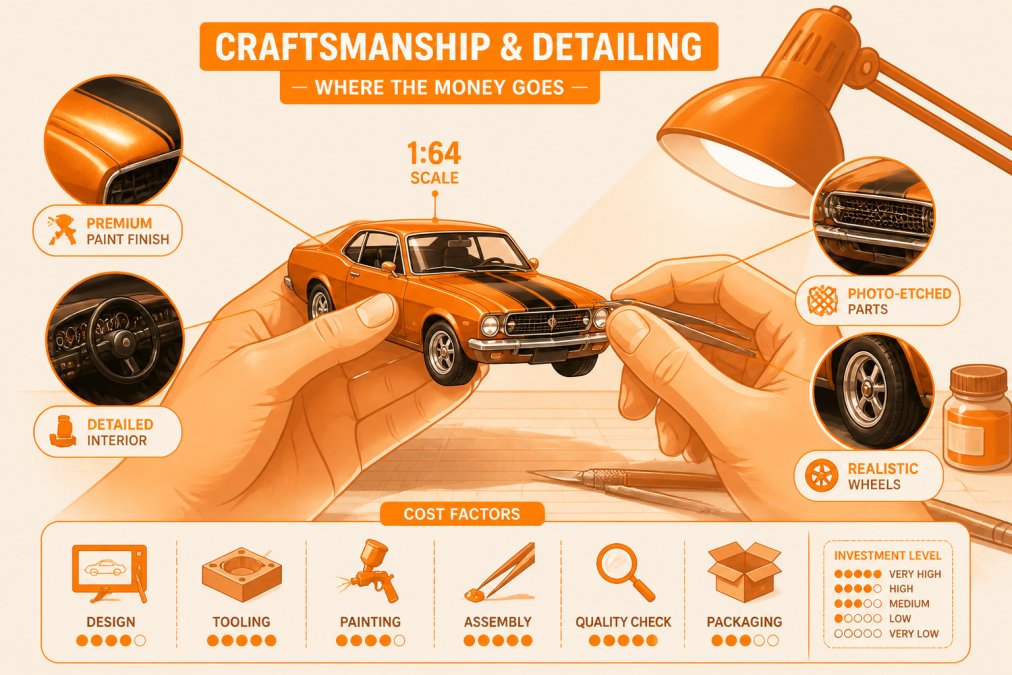
What most guides miss is the cost of consistency. A premium brand does not just produce one good model; it produces thousands that match a standard. That requires inspection stations, rework allowances, and packaging that protects the paint finish in transit. For a retailer like childrenstoycloset.com, factory-sealed shipping is not a luxury. It is the only way to guarantee the collector receives a model in the condition the manufacturer intended.
But the most significant cost driver in modern detailing is the technological evolution that has raised collector expectations. Twenty years ago, a premium 1:64 model might feature a simple tampo-printed stripe and plastic headlights. Today, collectors expect multi-layer paint with a deep clear coat, separately molded plastic or metal light lenses, and tampo printing so precise it replicates a manufacturer's factory decals. This shift is not just aesthetic, it is a direct result of CAD design and 3D printing in prototyping.
Manufacturers now design every component in a virtual environment, which allows for tolerances and interlocking parts that were impossible with traditional hand-drawn tooling. 3D printing is used to create rapid prototypes for fit testing and for producing the master patterns from which production molds are cut. This reduces the risk of a flawed tool, but it also means that the detail level achievable in the final product is far higher. A modern premium casting can have over 50 individual components, each requiring its own mold, its own assembly step, and its own inspection. The cost of that complexity is hidden in the final price, but it is the primary reason a $25 Mini GT model can feature a fully detailed engine bay that a 2005-era $25 model lacked.

The hidden cost of this evolution is in the finishing process itself. Multi-stage paint systems require more factory floor space, more energy for curing ovens, and more skilled labor to manage the process. A run of 10,000 units with a five-stage paint process might take twice as long to complete as a run with a single coat. This time is money, and it is amortized across the run. The result is that the 'craftsmanship' you pay for is not just the skill of an individual assembler, but the entire industrial process that has been engineered to deliver a level of fidelity that was once reserved for 1:18 scale models.
For the collector, this means the price difference between a mainline and a premium casting is a direct reflection of the number of manufacturing steps involved. When you hold a premium model, you are holding the output of a process that includes CNC-machined molds, 3D-printed prototypes, multi-stage paint booths, and manual assembly of photo-etched parts. That is the real cost of the detail you see on the shelf.
How to Determine Diecast Car Value Before You Buy
Learning how to determine diecast car value requires looking past the MSRP and examining production run size, brand reputation, and condition. A limited edition of 5,000 units will hold value better than a mainline release produced in the hundreds of thousands. The secondary market often tells the truth: if a model sells consistently above its original price on resale platforms, the demand is real.
Condition is the decisive factor. Factory-sealed models in pristine packaging command a premium because they offer certainty. A model removed from its box, even if displayed carefully, loses that assurance. Buyers should verify that seals are intact and packaging shows no signs of repackaging. Rarity without condition is worth little to a serious collector.
Diecast Car Investment Value: Hobby or Asset?
Diecast car investment value is real but selective, and it behaves differently from most collectible markets. Unlike stocks or precious metals, a diecast model produces no income and carries storage and preservation costs. Its appreciation depends entirely on future demand from a finite community of hobbyists.
The models that appreciate share common traits: they are licensed replicas of iconic vehicles, produced in limited runs, and kept in mint condition. A Hot Wheels Car Culture release honoring the Ferrari 250 GTO, one of only 36 real cars ever built, carries cultural weight that drives demand. For most models, however, depreciation is the norm. Treat the hobby as a passion first and an investment second.

To understand where the real money is made and lost, you must separate the MSRP from the secondary market. The price you pay at retail is set by the manufacturer and reflects their costs plus margin. The price you can sell for is set by scarcity and demand in the resale ecosystem. This is where 'scalping' and artificial scarcity create price bubbles. A limited run of 3,000 units that sells out in pre-order will immediately appear on resale platforms at double or triple the MSRP, not because the manufacturing cost increased, but because the supply is fixed and demand is immediate. This dynamic is common in the diecast world, where hype cycles around new releases can inflate prices for weeks before they settle to a more rational level.
A more reliable indicator of long-term value is the 'secondary market floor.' After the initial hype fades, a model's price will settle to a level that reflects genuine collector demand. You can gauge this by tracking sold listings on auction sites over several months. If a model consistently sells at or above its original MSRP six months after release, it has a healthy floor. If it sells below MSRP, it was overproduced or lacked lasting appeal. This floor is your best guide to whether a model is a 'toy' or an 'investment-grade' piece.
There is also a hidden cost to holding diecast as an asset: preservation. Unlike a stock certificate, a diecast model is a physical object that degrades. To maintain value, you must invest in climate-controlled storage to prevent zinc pest (a crystalline corrosion that can distort the metal), UV-protective display cases to prevent paint fading, and archival-quality packaging to prevent box degradation. For a collection valued at several thousand dollars, the annual cost of a dehumidifier, display cabinets, and insurance can easily reach 2-3% of the collection's value. This carrying cost is rarely factored into the 'investment' conversation, but it is the difference between a profitable resale and a net loss.
Finally, distinguish between 'collector demand' and 'speculative demand.' Collector demand is driven by the historical significance of the real car and the quality of the replica. Speculative demand is driven by the fear of missing out on a limited drop. The former creates sustainable value; the latter creates volatility. A model of a mundane sedan, even in a tiny run, will not appreciate because no collector community exists for it. A model of a legendary race car, even in a larger run, will hold value because the community is broad and deep. The investment thesis is simple: buy what the community wants, not what the hype suggests.
Best Diecast Car Brands for Collectors and What They Charge
The best diecast car brands for collectors balance detailing quality, licensing authenticity, and production discipline. Hot Wheels Car Culture sits at the premium end of the 1:64 scale market, with models like the Hot Wheels Car Culture Exotic Envy, Lamborghini Reventon Roadster Diecast Model Car priced around $11 at childrenstoycloset.com.
For deeper realism, Mini GT produces 1:64 models with extensive detailing, such as the Mini GT x Mini GT 1:64 Nissan Skyline GT-R (R34) Kaido Star Racing V1 Diecast Model Car at approximately $25. At the top of the enthusiast range, Hot Wheels Garage Series models like the Hot Wheels Garage Ferrari 250 GTO Red Diecast Model Car command around $75, reflecting their limited availability and the significance of the source vehicle. A common mistake is assuming higher price always means better quality. The right brand depends on whether you prioritize affordability, detail fidelity, or investment potential.

Serious collectors seeking specific series like Acceleracers or Fast and Furious models should shop with retailers that maintain searchable catalogs and factory-sealed inventory. The assurance of authentic, unopened product is worth the premium over auction sites where condition claims are harder to verify.
Understanding why are diecast cars so expensive comes down to recognizing that you are paying for engineering, licensing, and scarcity, not just metal. The models that reward collectors are those where the manufacturing cost is matched by genuine demand and careful preservation. At childrenstoycloset.com, we stock factory-sealed collectible diecast models across Hot Wheels, Disney Cars, Greenlight, and Auto World, with specialized series for dedicated fans. Browse our catalog to find the next piece for your collection and BUY NOW with confidence.
Frequently Asked Questions
Are diecast cars worth any money?
Yes, many diecast cars hold or increase their value, but it depends on the brand, scale, and condition. Limited production runs from brands like Hot Wheels Car Culture or Mini GT often sell at or above MSRP on the secondary market. A factory-sealed model with pristine packaging commands a premium. To determine if a specific car is worth money, check recent sold listings on auction sites rather than asking prices, and look for rare series like Acceleracers or specific Fast and Furious models.
Why do limited edition diecast models cost more?
Limited edition models cost more because the manufacturer spreads the same fixed costs, like tooling and licensing, across a smaller production run. A casting produced at 10,000 units has a higher per-unit cost than one produced at 100,000 units. Collectors also pay for exclusivity and rarity, which supports the diecast car investment value. Brands often add premium materials like photo-etched metal and rubber tires to justify the higher price point on these special releases.
Does brand name affect the resale value of diecast cars?
Brand reputation plays a major role in resale value. Established brands like Hot Wheels, Auto World, and Greenlight have loyal followings and consistent quality control, which builds collector confidence. For the best diecast car brands for collectors, look for consistency in detailing and paint finish. A rare model from a lesser-known brand rarely fetches the same price as a comparable model from a top-tier manufacturer, simply because demand is lower and the secondary market is thinner.
Will diecast cars go up in value over time?
Some diecast cars appreciate, but treating them as guaranteed investments is risky. Models from popular series like Acceleracers or the Ferrari 250 GTO have seen strong gains on the secondary market. However, mass-produced mainline cars often depreciate because supply exceeds demand. To maximize diecast car investment value, focus on limited editions, factory-sealed condition, and models with cultural significance. The longer you hold a rare piece, the more likely it is to exceed its original MSRP.
This article was written using GrandRanker