

Table of Contents
- What Factory Sealed Diecast Cars Actually Means
- Hot Wheels Case Code Identification Explained
- How to Tell If Hot Wheels Packaging Is Resealed
- How to Spot a Super Treasure Hunt Car in a Factory Case
- Regional Packaging Variations and International Cards
- Verifying Factory Sealed Diecast Cars Before You Buy
- Frequently Asked Questions
Last Updated: September 1, 2026
What Factory Sealed Diecast Cars Actually Means
Factory sealed diecast refers to a model car that has never been opened, altered, or repackaged since it left the manufacturer's production facility. The original factory seal is intact, packaging shows no signs of tampering, and contents are in exactly the condition the manufacturer intended. For collectors, this distinction is everything: a factory sealed piece commands higher resale value, maintains mint condition, and guarantees the model inside matches what the assortment code promises.

At childrenstoycloset.com, we specialize in factory sealed diecast cases and individual cards. The collector market draws a hard line between sealed and unsealed. A model removed from its blister card, even briefly, loses collector grade status. A case opened and repacked loses its integrity as a factory case. These distinctions exist because resale value depends entirely on authenticity.
Mainline Cases vs. Premium Collector Sets
Mainline cases are standard shipping cartons distributed to retail stores, typically containing 72 Hot Wheels cars per case in individual blister cards. Each carton carries a unique assortment code identifying exactly which models are inside.
Premium collector sets ship in smaller quantities with more elaborate packaging, often featuring real rider tires and Spectraflame paint finishes in collector-grade presentation boxes. The factory seal on premium sets is typically a tamper-evident sticker or heat-shrink wrap applied directly to the collector box.
Sealed Resin Models vs. Sealed Diecast: Key Differences
Resin models are cast from polyurethane or similar compounds in limited runs by specialty manufacturers. Diecast models use zinc alloy or similar metals injected into molds under pressure, producing the heavier, more durable construction collectors associate with Hot Wheels, Greenlight, and Auto World.
For sealed verification: resin models often ship in foam-lined presentation boxes with paper seals, while diecast mainline cars ship on blister cards. Diecast blister cards have specific factory seal characteristics around the card edge that are harder to replicate convincingly.
Hot Wheels Case Code Identification Explained
Hot Wheels case code identification is the process of reading the alphanumeric codes printed on the outside of a factory shipping carton to determine the exact assortment contents, production batch, and model year.

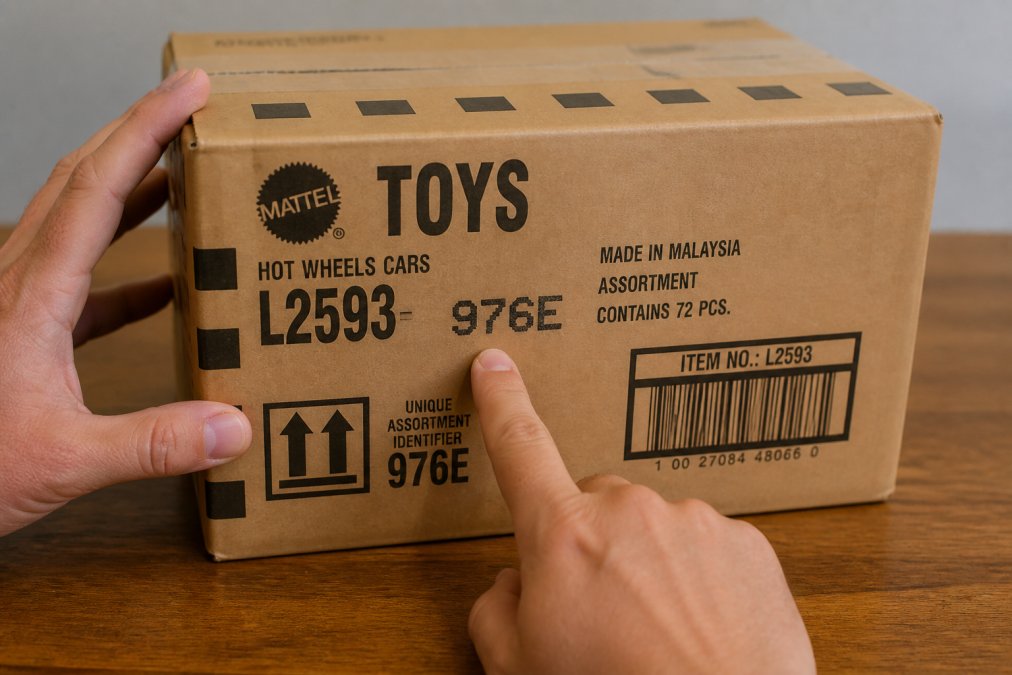
Reading the Assortment Code and Case Letter
The assortment code is a multi-digit number printed on the carton label, typically in the format HXX-XXXX. This code identifies the specific product line and series. The case letter follows the assortment code and runs alphabetically (A, B, C, D...) to indicate the revision of that assortment. Case A is the first production run; later letters represent updated mixes with different model variants.
This matters for treasure hunt hunters and variant collectors. Many super treasure hunt cars appear in specific case letters, not across all runs. Buying a case without checking the case letter means you may be purchasing an assortment that doesn't contain the variant you're after.
| Code Element | What It Tells You | Example |
|---|---|---|
| Assortment number | Product line / series | HXX-0000 |
| Case letter | Production revision | Case D |
| Distribution code | Regional market | US, EU, INTL |
| Manufacturing date | Production batch | Week/Year stamp |
| UPC/barcode | Retail inventory tracking | Standard barcode |
Decoding Production Year and Manufacturing Date from Box Markings
The manufacturing date is usually stamped near the barcode on the carton's side or bottom panel. Hot Wheels uses a date code format that includes the production year and the production week. A code reading 2025-W32 indicates the 32nd week of 2025 production.
Production year helps verify that a "sealed" case is genuinely from the year it's claimed to be. According to the Hot Wheels collector community documentation on case codes, the base code printed on individual blister cards also carries a model year identifier that should align with the case's production date. Cross-referencing these is one of the most reliable double-checks available to collectors.
How to Tell If Hot Wheels Packaging Is Resealed
Resealed Hot Wheels packaging is more common in the secondary market than most buyers acknowledge. The tell-tale signs are visible on close inspection, but they require knowing exactly what a genuine factory seal looks like.
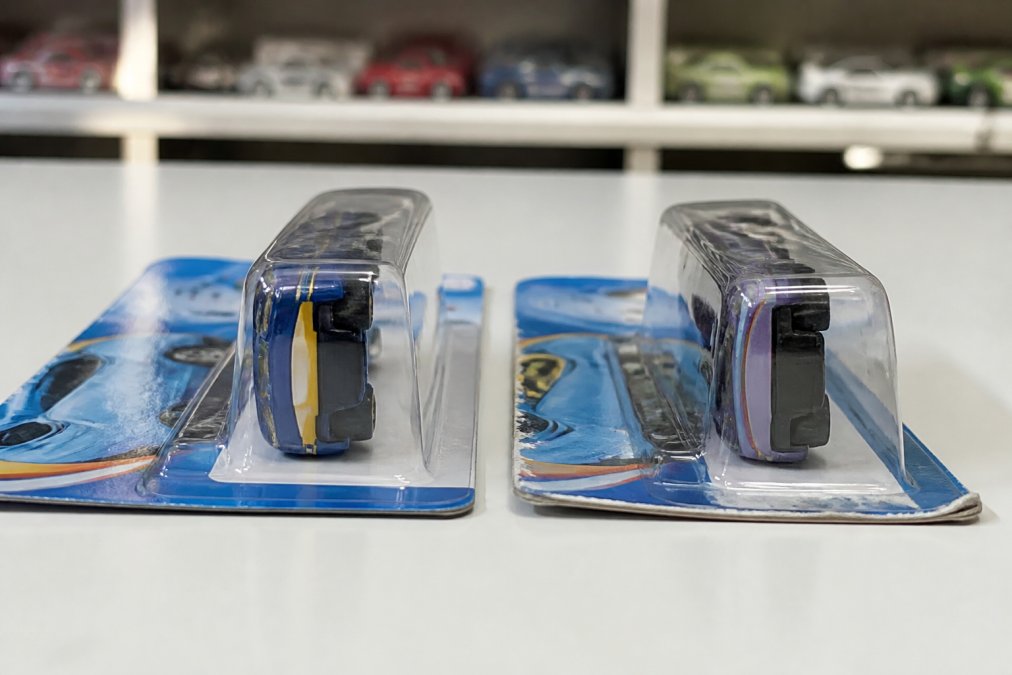
Blister Card and Short Card Inspection
Blister cards are the standard backing cards used for mainline Hot Wheels. The plastic bubble is heat-sealed directly to the card stock using a specific pattern of contact points. Genuine factory seals show even, uniform contact around the entire bubble perimeter with no gaps, bubbling, or residue.
Short cards are the smaller format cards introduced in later production years. The same inspection principles apply, but short cards have less surface area, making any irregularity more visible.
What to look for on a genuine factory sealed card:
- Uniform card stock with no warping, moisture damage, or creasing along the seal edge
- No visible glue residue, dried adhesive, or white residue around the bubble edge
- The card's printed surface shows no signs of heat exposure or discoloration
- The bubble sits flush against the card with no air gaps at the edges
- The hang tab hole is clean and undeformed
A resealed card typically shows at least one of these failure points. The most common giveaway is glue residue or a slightly uneven bubble edge where the original seal was broken and re-adhered.
Physical Tampering Detection: What to Look For
Check the bubble interior for complete clarity with no fingerprints, dust accumulation, or fogging. Any cloudiness inside a "sealed" bubble indicates the package was opened and resealed. Examine the card's printed surface under direct light at an angle. Genuine factory cards have a consistent print finish. Heat from resealing tools often creates subtle discoloration or a slight sheen change around the bubble perimeter.
Check the model itself: if you can see the car clearly through the bubble, verify that the wheels are positioned naturally. Cars that have been removed and replaced often have slightly misaligned wheel positions or visible handling marks on the body.
How to Spot a Super Treasure Hunt Car in a Factory Case
Super treasure hunts are distinguished from regular treasure hunts by three specific features: a Spectraflame paint finish, Real Rider rubber tires, and a "$uper" TH logo on the car's base or body.
From outside a sealed case, you cannot see the cars directly. The approach collectors use is case letter tracking. Super treasure hunt cars appear at a rate of roughly one per case, but their placement within specific case letters is tracked extensively by the collector community. Resources like the Hot Wheels collector database maintain historical records of which case letters have contained super treasure hunts for each model year.
The practical workflow for super treasure hunt hunting in sealed cases:
- Identify the model year and assortment code on the carton
- Cross-reference the case letter against community tracking databases
- Verify the manufacturing date aligns with the claimed production run
- Check that the carton shows no signs of previous opening
A sealed case that has been opened and repacked to remove the super treasure hunt will show damage at the carton's closure points. Factory cases are typically sealed with specific tape patterns or glued flaps. Repacked cases rarely replicate these closure patterns exactly.
Regional Packaging Variations and International Cards
Regional packaging variations are a genuine source of confusion for collectors. Hot Wheels and similar manufacturers produce packaging variations for different markets, and these differences affect how factory sealed authenticity is assessed.
International blister cards often differ from US market cards in language text, UPC barcodes, distribution codes, and sometimes card stock color or finish. A card with European distribution codes sold as a US market item isn't necessarily fake, but the mismatch should be disclosed by the seller.
Some international markets continued receiving long card format packaging after the US transition to short cards. Packaging variations also affect treasure hunt identification. Some international releases omit the "TH" symbol used on US market cards, making standard treasure hunt identification methods unreliable. The International Diecast Collectors Association resources maintains documentation on known regional packaging variations that collectors can reference when evaluating international stock.
Verifying Factory Sealed Diecast Cars Before You Buy
Verifying factory sealed diecast cars before purchase requires combining physical inspection with source verification. Neither alone is sufficient: a physically intact package from a compromised source carries the same risk as a suspicious package from a reputable one.
Digital Verification Tools and Community Resources
Assortment code lookup tools allow collectors to input the code from a carton and verify that the claimed contents match the manufacturer's published assortment. Photo authentication has become standard practice in higher-value transactions. Collectors request specific photos: the carton's assortment code label, the manufacturing date stamp, the closure seam under direct light, and individual card edges for any cards being sold separately. Any seller of genuine factory sealed stock should accommodate these requests without hesitation.
For premium releases and limited collector sets, some manufacturers have introduced digital verification elements including QR codes and serial number registries. These are worth checking where available, though they're not yet universal across the diecast category.
Where to Source Genuine Factory Sealed Cases
Sourcing matters as much as inspection. The most reliable sources for factory sealed diecast cases are authorized retailers who receive inventory directly from manufacturer distribution channels. Secondary market platforms introduce risk at every step of the chain.
At childrenstoycloset.com, our inventory includes factory sealed cases and individual sealed cards across Hot Wheels, Greenlight, Disney Cars, and Auto World. Products like the Hot Wheels 2025 Super Treasure Hunt Ford RS200 Factory Sealed Diecast Model Car ship with Spectraflame finish and Real Rider wheels intact, sealed as received from the manufacturer. The Hot Wheels 2025 Legends Tour Porsche 935 Factory Sealed Diecast Model Car is another premium sealed release available directly. For collectors focused on JDM culture, the Mini GT x Kaido House Honda Civic (EF) Works V1 SEALED Package and the Mini GT x Kaido House Datsun 510 Street Racing V2 SEALED Package represent sealed collector-grade options in the premium Mini GT line.

The price premium over secondary market listings reflects a shorter custody chain, not inflated margins. A sealed case with a documented source is worth more than an identically priced case with unknown history.
| Verification Factor | What to Check | Red Flag |
|---|---|---|
| Source type | Authorized retailer vs. secondary market | Multiple previous owners |
| Assortment code | Matches claimed contents | Code absent or obscured |
| Manufacturing date | Consistent with claimed production year | Date mismatch |
| Closure integrity | Original tape/glue pattern intact | Generic packing tape |
| Card edge condition | Clean seal, no residue | Glue marks, warping |
| Seller photo quality | Clear, direct-light images | Blurry or angled shots |
According to guidance from the Diecast Hall of Fame on authentication best practices, the single most reliable indicator of a trustworthy seller is their willingness to provide detailed provenance documentation alongside clear inspection photos.
Identifying factory sealed diecast cars correctly takes practice, but the framework is consistent: read the case codes, inspect the physical seals under direct light, cross-reference the manufacturing date, and verify your source. The mistakes that cost collectors money almost always trace back to skipping one of these steps. childrenstoycloset.com stocks factory sealed cases and individual sealed cards with full provenance from manufacturer distribution, so you're not relying on a stranger's word that a package is genuine. Browse our sealed inventory and buy with the confidence that comes from a verified source.
Frequently Asked Questions
Does factory sealed mean unopened?
Yes. Factory sealed means the product left the manufacturing facility in its original, closed state and has not been opened at any point in the distribution chain. For diecast cars, this applies both to individual blister cards sealed at the factory and to full shipping cartons containing a complete case mix. A factory sealed case guarantees the original case assortment is intact, with no models removed or swapped before you receive it.
Are factory sealed Hot Wheels worth more?
Factory sealed Hot Wheels, particularly full cases and premium collector sets, consistently command higher resale value than loose or opened examples. Sealed cases preserve mint condition packaging and guarantee the original case mix, which matters most for Super Treasure Hunts and Spectraflame variants. A factory sealed Super Treasure Hunt like the 2025 Ford RS200 holds significantly more collector grade value than the same model with damaged or opened packaging.
What are Hot Wheels case codes and how do they work?
Hot Wheels case codes are alphanumeric strings printed on the shipping carton that identify the assortment code, case letter, and production batch. The assortment code tells you which series or wave the case belongs to. The case letter (A, B, C, etc.) identifies the specific mix of models inside. Collectors use these codes for inventory tracking, to confirm which variants are included, and to date the manufacturing run before purchasing a sealed box.
How can you tell if a blister pack has been tampered with?
Check the perimeter where the blister meets the card. On a genuine factory seal, the bond is uniform with no gaps, lifted edges, or residue. Resealed packaging often shows faint glue marks, uneven pressure lines, or slight warping where the blister was separated and reattached. On short cards, inspect the back for staple holes or re-glued areas. Under bright light, tamper-evident seals on premium cases will show distortion or missing holographic patterns if disturbed.
This article was written using GrandRanker