

Table of Contents
- Why Proper Storage Matters for Diecast Car Collections
- Climate Control and Moisture Prevention
- How to Prevent Diecast Paint Rash During Storage
- Best Storage Boxes for Hot Wheels and 1:64 Scale Models
- Diecast Car Display Cases: Display vs. Long-Term Storage
- How to Store Collectible Diecast Cars: Handling and Cleaning
- Digital Inventory, Insurance, and Disaster Preparedness
- Conclusion: Protecting the Value of Your Diecast Collection
- Frequently Asked Questions
Last Updated: August 31, 2026
Why Proper Storage Matters for Diecast Car Collections
The best ways to store collectible diecast cars come down to three things: controlling the environment, choosing the right materials, and keeping detailed records. Get any one of these wrong and you risk paint rash, corrosion, or a collection worth a fraction of what you paid. At childrenstoycloset.com, we've shipped thousands of factory-sealed diecast models to collectors who understand that acquisition is only half the battle. The other half is preservation.
Diecast car storage is the practice of protecting metal and plastic scale models from environmental damage, physical contact, and chemical degradation over time. Done correctly, it maintains mint condition and resale value for decades. Done carelessly, it destroys rare models within years. Collectors who store models without climate control, in plastic bags made from the wrong polymer, or in direct sunlight report yellowed clear parts, lifting decals, and paint rash that spreads from one model to the next. This guide covers every layer of protection your collection needs, from humidity management to digital insurance documentation.
Climate Control and Moisture Prevention
Moisture is the primary enemy of a diecast collection. Metal alloys corrode, paint lifts, and paper inserts deteriorate when humidity fluctuates. The ideal storage environment sits between 40% and 50% relative humidity, with consistent temperatures rather than seasonal swings.
Garages, attics, and basements experience the widest temperature and humidity swings throughout the year. A model stored in a garage can experience condensation forming on its surface as temperatures drop overnight, enough to start corrosion on exposed metal parts. Climate-controlled interior rooms are the correct choice. A dedicated spare room with consistent HVAC is ideal. If space is limited, a sealed cabinet with active humidity control works as a practical alternative.
Using Desiccants and Airtight Containers
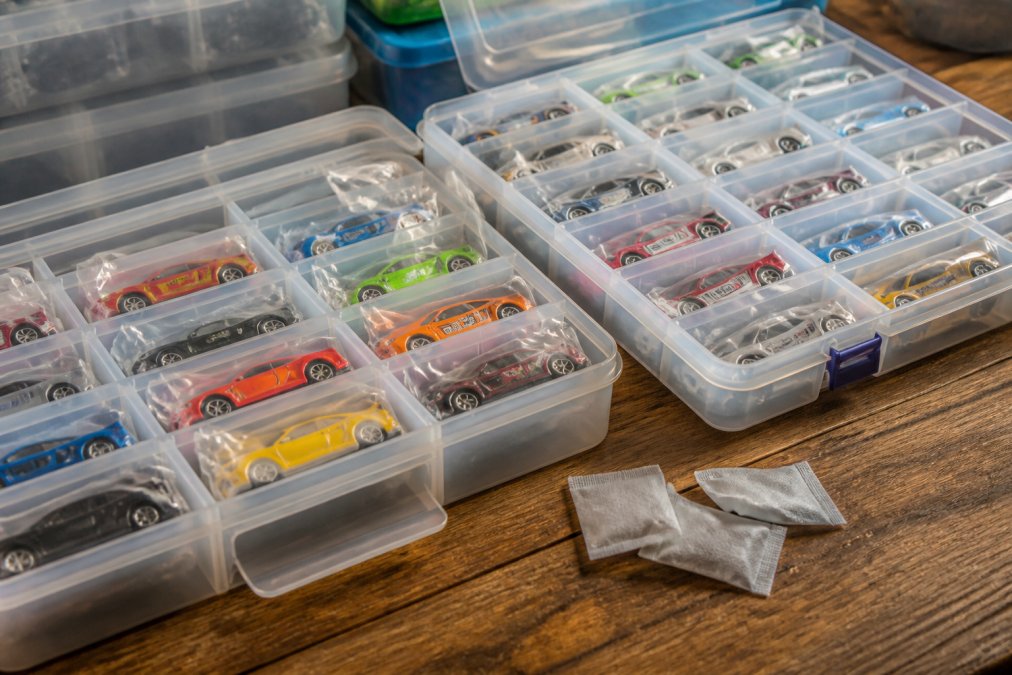
Desiccants are moisture-absorbing packets placed inside storage containers to maintain low humidity levels. Silica gel is the most widely available option. Reusable silica gel packets that change colour when saturated are worth the small premium, they tell you exactly when to replace them without guessing.
For airtight storage, look for containers with rubber-gasketed lids. A container that's merely "snap closed" allows air exchange over time. Place one or two desiccant packets per container depending on its volume, and check them every three to six months.
How to Prevent Diecast Paint Rash During Storage
Paint rash is the silvery, metallic flaking that appears on diecast car bodies when paint separates from the metal substrate. Once it begins, it cannot be reversed. Prevention is the only strategy.
Paint rash has two primary causes: contact with other metal surfaces and chemical off-gassing from incompatible plastics. Many collectors discover paint rash only after opening a storage bin to find that a carefully placed model has developed dozens of silver spots.
Poly Bags, Tissue Paper, and Protective Wraps
Poly bags create a barrier between the model and anything it might contact. For 1:64 scale models like Hot Wheels, small resealable bags work well and allow you to see the model without opening the seal.
Acid-free tissue paper adds a second layer of protection for models stored outside their original packaging. Wrap the model before placing it in a bag, the tissue paper prevents direct contact between the paint surface and the plastic bag itself.
For larger scale models and high-value pieces, bubble wrap provides cushioning against impact. Use bubble wrap as an outer layer over tissue paper, not directly against the paint surface.
Chemical Compatibility: Which Plastics Are Safe
Not all plastics are chemically inert. Some common storage plastics off-gas compounds over time that react with diecast paint and accelerate paint rash. The safest plastics for long-term diecast storage are those marked with recycling codes 2 (HDPE), 4 (LDPE), and 5 (PP). Avoid PVC (code 3) for direct contact with models. PVC releases plasticizers over time that migrate into paint layers and cause softening and adhesion failure.
As documented in guidance from the American Institute for Conservation on material safety for collections, PVC-based materials are widely recognised as incompatible with long-term preservation of painted surfaces and should be excluded from collection storage environments.
Best Storage Boxes for Hot Wheels and 1:64 Scale Models
The 1:64 scale format creates specific storage challenges. These small cars are easy to accumulate in large numbers, making organisation as important as protection. A disorganised collection of several hundred models is effectively inaccessible.
The two dominant approaches are compartmentalized bins and stackable cases. Both have genuine advantages, and the right choice depends on collection size and how frequently you access individual models.
Compartmentalized Bins vs. Stackable Cases
Compartmentalized bins are shallow trays with individual cells sized for 1:64 scale models. Each car sits in its own compartment, visible from above, with no contact between models. These trays stack inside larger storage bins. The advantage is density: a single standard storage bin can hold 50 to 100 models depending on tray configuration.
Stackable cases are purpose-built for diecast storage and typically feature clear lids that allow viewing without opening. Many are designed to interlock for stable vertical stacking. The main advantage is accessibility. You can pull a single case from a stack and examine models without disturbing the rest of the collection.
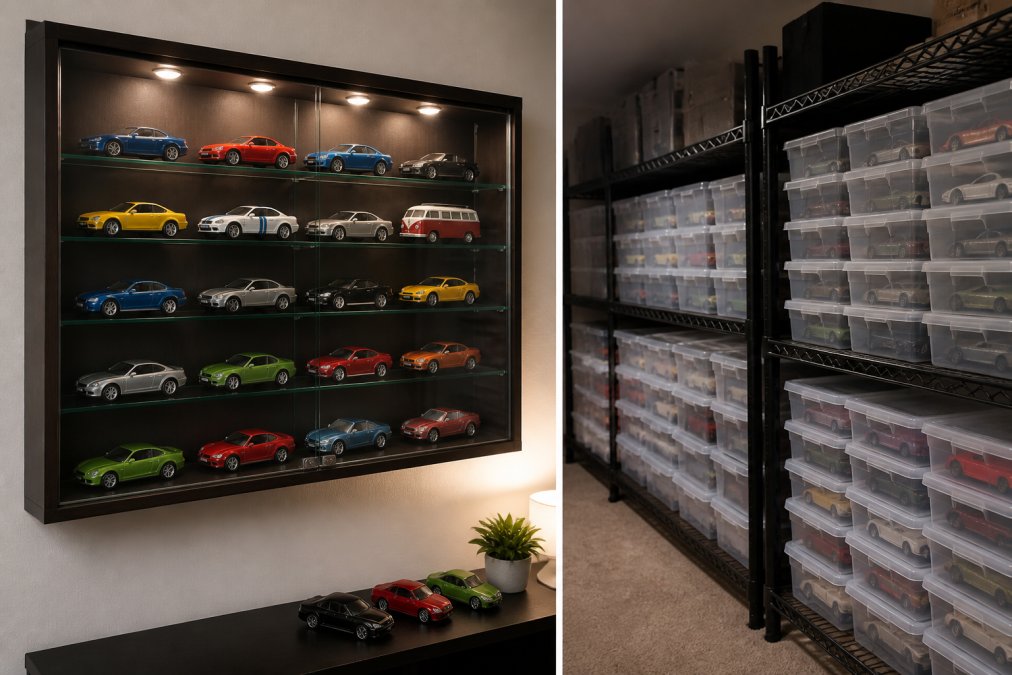
For a collection under 200 models, stackable cases offer the best combination of protection and accessibility. For larger collections, compartmentalized bins inside labelled storage containers become more practical from a space efficiency standpoint.
| Storage Method | Best For | Capacity | Visibility |
|---|---|---|---|
| Compartmentalized bins | Large collections (200+) | High | Requires opening |
| Stackable clear cases | Smaller collections | Medium | Clear lid viewing |
| Original blister packs | Mint-in-package collectors | 1 per pack | Full visibility |
| Archival display cases | Display and preservation | Low | Full visibility |
Managing Original Packaging and Blister Packs
Original packaging significantly affects a collectible's value. A Hot Wheels model in its original blister pack is worth considerably more than the same model loose, particularly for older or limited-run releases. Store blister packs vertically, like books on a shelf, rather than stacking them flat. Flat stacking puts pressure on the card backing and can cause the blister to separate over time.
Protective sleeves designed for trading cards work well for standard blister pack sizes. For non-standard packaging, acid-free archival sleeves cut to size provide the same protection. The goal is to prevent the card from absorbing moisture and to shield the packaging from physical contact.
Diecast Car Display Cases: Display vs. Long-Term Storage
Display and long-term storage are not the same objective. Display prioritises visibility and aesthetics. Long-term storage prioritises protection from light, humidity, and physical contact. A model on open display is actively exposed to UV radiation, airborne dust, and humidity fluctuations.
Diecast car display cases are enclosed units, typically with glass or acrylic panels, that allow viewing while providing a barrier against dust and contact damage. The best display cases incorporate UV-filtering panels to prevent paint fade and decal yellowing.
UV Protection and Archival-Quality Cases
UV radiation fades paint, yellows clear plastic parts, and degrades decals. Models displayed near windows or under fluorescent lighting without UV filtering show visible colour shift within a few years. This is irreversible.
Archival-quality display cases use UV-filtering acrylic or glass that blocks a high percentage of ultraviolet wavelengths. Standard acrylic does not provide meaningful UV protection. When evaluating display cases, look specifically for UV-filtering specification. For models you want to both display and preserve at the highest level, rotate display models every few months to limit cumulative UV exposure.
According to the Library of Congress preservation guidelines for objects and materials, UV radiation is one of the primary causes of irreversible deterioration in collected objects, and filtering it at the source is more effective than attempting to reverse damage after it occurs.
How to Store Collectible Diecast Cars: Handling and Cleaning
Proper handling before storage prevents contamination that causes long-term damage. Skin oils transfer to paint surfaces during handling. Over time, these oils attract dust, promote corrosion, and can cause paint adhesion issues. Handle models with clean cotton gloves or hold them by the base or chassis rather than the body.
Cleaning before storage removes contaminants that would otherwise sit against the paint surface for months or years. For loose models, a soft brush removes dust without contact pressure. A microfibre cloth works for light surface cleaning. Avoid any cleaning product containing solvents, as these can strip paint, particularly on older models.
For models with chrome or metallic finishes, avoid cleaning products entirely unless dealing with visible contamination. A gentle blast of compressed air is safer than any contact cleaning method. Allow models to air-dry completely in a low-humidity environment before sealing them in airtight containers.
Digital Inventory, Insurance, and Disaster Preparedness
Most collectors underestimate how difficult it is to recall the details of every model in a large collection. A digital inventory system solves this problem while tracking purchase prices and identifying provenance.
Building a Digital Inventory System
A digital inventory should capture, at minimum: model name, series, scale, manufacturer, condition, purchase date, purchase price, and storage location. Photographs of each model, including identifying marks or packaging details, add significant value when verifying condition or identifying a specific release.
Spreadsheet software works for smaller collections. Dedicated collection management apps offer more structure for larger inventories, including the ability to tag models by series, search by manufacturer, and track value changes over time. The key is consistency. Back up your inventory data in at least two locations: a cloud backup and a local backup on an external drive.
As recommended in guidance on personal property inventory best practices from the Insurance Information Institute, maintaining a documented inventory with photographs is the single most effective step collectors can take to support insurance claims after loss or damage.
Valuation Documentation and Insurance
Rare and limited-edition diecast models can carry significant monetary value. A collection assembled over years may represent a substantial financial investment that standard home contents insurance does not adequately cover. Standard policies typically apply depreciated value to personal property rather than collector market value, resulting in significant undercompensation after a loss.
Specialist collectibles insurance covers items at their current market value. For high-value individual pieces, a written appraisal from a recognised collector or auction house provides the strongest documentation. Keep a copy of your inventory and valuation documentation stored offsite or in cloud storage. In the event of fire, flood, or theft, your physical collection and local records can both be lost simultaneously. An offsite copy is the only way to support a claim accurately.
The childrenstoycloset.com team recommends treating documentation as part of the storage process itself. When a new model arrives, photograph it, log it, and file the receipt before it goes into storage. Building the habit at acquisition time is far easier than trying to reconstruct records retroactively.
Conclusion: Protecting the Value of Your Diecast Collection
Protecting a diecast collection long-term requires consistent attention across climate control, material selection, handling practices, and documentation. The collectors who preserve mint condition across decades treat storage as a system, not an afterthought. childrenstoycloset.com sources factory-sealed models from brands including Hot Wheels, Greenlight, and Auto World precisely because condition at acquisition determines the ceiling for long-term preservation. Start with the right model, store it correctly from day one, and your collection holds its value. Browse the current inventory at childrenstoycloset.com to find the models worth protecting.
Frequently Asked Questions
How do you prevent diecast paint rash during storage?
Paint rash happens when two diecast models rub against each other or against rough surfaces. Store each car in an individual poly bag or wrap it in acid-free tissue paper before placing it in a compartmentalized bin. Never stack bare models directly on top of one another. For high-value pieces, a protective sleeve or dedicated display case with foam lining gives the best defence against surface damage and keeps the paint in mint condition long-term.
Are there special storage boxes for diecast toy cars?
Yes. Compartmentalized plastic organizer bins designed for 1:64 scale models are widely available and let you separate each car to prevent scratching. Stackable cases with adjustable dividers work well for larger collections. For blister-packed Hot Wheels still in original packaging, flat-bottomed storage boxes with acid-free inserts protect the card without bending corners. Choose containers made from polypropylene or polyethylene, as these plastics are chemically stable and won't off-gas compounds that damage paint or decals.
Will collectible diecast cars go up in value?
Some do, particularly factory-sealed, limited-edition, or series-specific models from brands like Hot Wheels, Greenlight, and Auto World. Resale value depends heavily on condition: mint-condition cars in original packaging consistently command higher prices than opened or damaged examples. Proper storage, climate control, UV protection, and individual wrapping, is the most reliable way to preserve whatever value a model has at the time of purchase. There are no guarantees, but poor storage almost always reduces value.
What are some creative DIY ideas for storing diecast cars at home?
Shallow wooden shadow boxes mounted on walls make attractive display options while keeping models dust-free. Repurposed fishing tackle boxes with adjustable compartments work well for 1:64 scale cars. Clear acrylic risers inside a locked cabinet create a tiered display that's easy to photograph for inventory purposes. For long-term storage rather than display, vacuum-sealed poly bags with a desiccant packet inside each one offer strong moisture control without buying specialist archival containers.
This article was written using GrandRanker