

Table of Contents
- Why Finding a Specific Diecast Car Series Gets Harder Every Year
- Start With the Scale: 1:64, 1:24, and 1:18 Explained
- How to Identify Diecast Car Series Using Catalog Numbers and Batch Codes
- How to Verify Factory Sealed Diecast Models Before You Pay
- Where to Find Rare Diecast Models Without Getting Burned
- Evaluating Model Quality: Paint Finish, Casting, and Interior Detail
- Common Mistakes When Hunting a Specific Series
- Frequently Asked Questions
Last Updated: September 21, 2026
Why Finding a Specific Diecast Car Series Gets Harder Every Year
Finding a specific diecast car series is harder because manufacturers flood the market with more castings, color variants, and short-run exclusives than ever. A single model can appear in a dozen versions in one year.
Start With the Scale: 1:64, 1:24, and 1:18 Explained
Scale is the first filter, eliminating most wrong matches before you spend a cent. It's the size ratio between model and real car: a 1:64 model is 64 times smaller.
Here's how the three main scales compare:
| Scale | Typical Size | Common Series | Best For |
|---|---|---|---|
| 1:64 | 7-8 cm long | Hot Wheels, Matchbox | Volume collectors, series runs |
| 1:24 | 18-20 cm long | Auto World, Greenlight | Display, opening parts |
| 1:18 | 25-30 cm long | Premium replica lines | Detail-focused collectors |
Which Scale Belongs to Which Series
Series and scale usually travel together. Hot Wheels mainlines and Treasure Hunts live in 1:64. Greenlight and Auto World lean toward 1:24 and 1:64. Premium replica makers work almost exclusively in 1:18.
How to Identify Diecast Car Series Using Catalog Numbers and Batch Codes
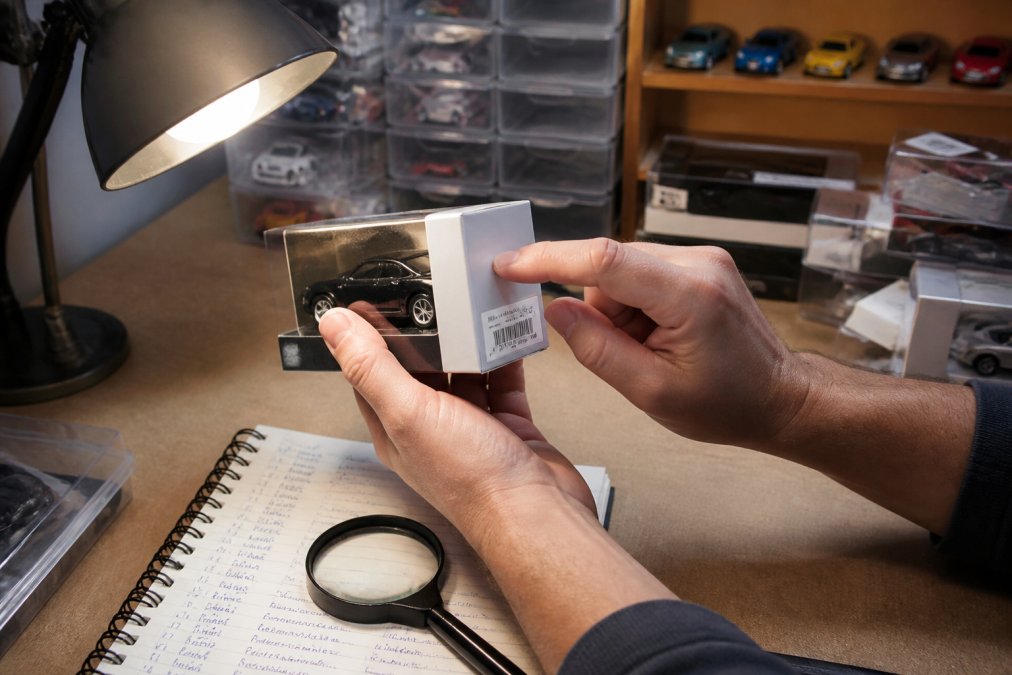
Catalog numbers are the most reliable way to identify a diecast car series. Every mass-produced model carries a code tying it to a specific year, series, and production run, yet most collectors read the box art instead.
Where the Codes Actually Live
Placement varies by manufacturer and packaging type:
- Hot Wheels mainline cards: The collector number sits on the back of the card, usually near the barcode. The series name (e.g., "HW Screen Time") is printed above it. The year is often stamped separately.
- Matchbox: Look for the "MB" prefix followed by a number on the back of the card or the base of the car. Matchbox also prints a manufacturing date code on the base.
- Greenlight: The item number (often starting with a series prefix) appears on the box end flap and the bottom of the box. Greenlight also prints a production run quantity on limited editions.
- Auto World: The catalog number is on the box end and the base of the car. Auto World uses a "SC" prefix for some series.
- Johnny Lightning: The item number is on the back of the card and the base. White Lightning chase pieces have a separate code.
If no code appears on the packaging, check the base of the car, many manufacturers stamp a code or date there.
How to Decode a Catalog Number
Catalog numbers usually follow a pattern:
- Year prefix: The first one or two digits often indicate the model year or series year. For example, a code starting with "22" may indicate a 2022 release.
- Series code: A letter or short string identifies the series (e.g., "HW" for Hot Wheels mainline, "TH" for Treasure Hunt).
- Collector number: The final digits place the car within the series run. This is the number you use to look up the exact casting.
A common mistake is trusting the front of the package alone. Artwork often stays the same across a series run while the code underneath changes, so two identical-looking cars can belong to different batches.
Reading Serial Numbers and Production Runs
Serial numbers and batch codes tell you when a car was made and how many were produced, where the real finds hide.
Here's what to look for:
- Batch codes usually appear as a short letter-number string near the barcode. They indicate the factory and the week of production.
- Production runs are often listed in manufacturer catalogs by year and series number. Limited editions may state the run size (e.g., "1 of 5,000").
- Case codes on sealed cases reveal which short-packed cars are inside. A case code like "A" or "B" can tell you whether a chase piece is possible.
- Tampo codes on the car itself confirm the exact deco version. A tampo is the printed graphic; a different tampo code means a different release even if the casting is the same.
Cross-Referencing Historical Catalogs and Series Lists
Manufacturers publish annual catalogs listing every casting, series, and code for that year; collector communities archive older ones. Work backward from a code to a confirmed series:
- Identify the manufacturer and year from the code prefix.
- Find the annual catalog for that year. Physical catalogs were distributed to hobby shops; digital scans are often shared in collector forums and archival sites.
- Match the collector number to the series list in the catalog. The catalog will show the casting name, series name, and sometimes the production run.
- Cross-check with a community database. Sites like the Hot Wheels Wiki, Matchbox University, and manufacturer-specific collector databases maintain searchable lists by year, series, and code.
- Verify with a second source. If the catalog and the database disagree, trust the physical code on the item and look for a third source.
Using Manufacturer Databases and Collector Archives
Some manufacturers maintain their own product archives. Hot Wheels has a searchable collector database by year and series; Greenlight and Auto World publish PDF catalogs on their websites, the most authoritative sources.
How to Verify Factory Sealed Diecast Models Before You Pay
Verifying factory sealed diecast models means checking the seal, tape, and case code together. A sealed box is not automatically untouched.
Check these before you pay:
- Tape condition: Factory tape sits flat with clean edges. Resealed tape wrinkles or lifts at the corners
- Blister seal: The card-to-blister bond should be even. Lifting or cloudy glue means it was opened
- Case code match: The car inside should match the code on the outer packaging
- Weight and rattle: A sealed case has a consistent feel. Loose contents suggest tampering
Condition Grading Standards Collectors Actually Use
Condition grading is where most listings get vague. "Mint" means different things to different sellers.
| Grade | Car Condition | Packaging Condition |
|---|---|---|
| Mint | No flaws, unplayed | Sharp corners, no creases |
| Near mint | Tiny handling marks | Minor shelf wear |
| Good | Light play wear | Visible creases, intact |
| Loose | Played with | No packaging |
Where to Find Rare Diecast Models Without Getting Burned
Rare models surface in a handful of predictable places, each with different risk. The difference between a good find and a bad one is the verification workflow you apply before paying.
Source-by-Source Risk and Verification
Specialist online retailers stocking factory-sealed cases and hard-to-find series are the lowest-risk source for sealed product. Ask for the case code and a photo of the seal before purchase; reputable retailers provide both.
Condition Grading Standards Collectors Actually Use
| Grade | Car Condition | Packaging Condition |
|---|---|---|
| Mint | No flaws, unplayed, no paint defects | Sharp corners, no creases, no price stickers |
| Near mint | Tiny handling marks, no play wear | Minor shelf wear, one small crease allowed |
| Excellent | Light play wear, paint intact | Visible creases, corners soft, intact blister |
| Good | Moderate play wear, paint chips possible | Heavy creases, torn card, blister may be lifting |
| Loose | Played with, no packaging | No packaging |
Ask for photos of both the car and the packaging, a seller who only shows the car is hiding something about the card. For sealed items, request a photo of the seal and case code; refusal is a red flag.
A Pre-Purchase Verification Checklist
Before paying for any rare model, run this checklist:
- Confirm the code. Ask for a clear photo of the catalog number and batch code.
- Match the code to the series. Use the manufacturer catalog or a community database.
- Check the scale. Confirm it matches the series you are targeting.
- Grade the condition. Use the table above and ask for photos of both car and packaging.
- Verify the seal if sealed. Look for flat factory tape, even blister seal, and a case code that matches the car inside.
- Confirm return policy. If the seller does not accept returns on misrepresented items, walk away.
Using Historical Catalogs to Find Discontinued Series
Discontinued series are hardest to find because they're no longer in production and often absent from manufacturer websites. Work from historical catalogs:
- Physical catalogs from hobby shops and collector estates are often sold on auction sites and at swap meets, listing every casting and series for a given year.
- Digital archives maintained by collector communities often include scanned catalogs. Search the manufacturer name plus "catalog" plus the year.
- Collector books such as the Standard Catalog of Die-Cast Vehicles (published by Krause) cover multiple manufacturers with series lists and production notes.
Evaluating Model Quality: Paint Finish, Casting, and Interior Detail
Quality separates a display piece from a shelf filler. Three things decide it: paint finish, casting sharpness, and interior detail.
Common Mistakes When Hunting a Specific Series
Most failed hunts come down to the same errors. Avoid these and you'll save money and time.
- Trusting the box art instead of the code. Artwork repeats across runs
- Skipping the scale check. Wrong scale means wrong series entirely
- Buying without photos of the packaging. Card condition drives value
- Assuming "sealed" means untouched. Resealing is common
- Not cross-referencing the catalog year. Codes only make sense in context
- Paying premium prices without a return option. No recourse if it's wrong
Every mistake comes from skipping a verification step.
Frequently Asked Questions
How can I verify if a diecast car is part of a specific series?
Check three things: the catalog number printed on the packaging, the series name on the card or box, and the casting name itself. Match that catalog number against a historical series list for the manufacturer. Chase and Super Treasure Hunt pieces often carry an extra tampo or a different wheel set, which confirms the series tier. If the number does not match any published run, treat it as a custom or repack. For a diecast car series like Hot Wheels Super Treasure Hunt, the Spectraflame paint and Real Riders wheels are the clearest signals.
What makes a diecast model genuinely rare?
Rarity comes from production run size, not age. Short-printed pieces, chase variants, and randomly inserted models are produced in far lower quantities than standard releases. The Mini GT #1139 Ford Mustang Mach 1 in Grabber Yellow is a good example: the Chase version is short-packed and randomly inserted into cases, which makes it one of the hardest pieces in that run to find at retail. Limited edition runs and discontinued series also climb in value once supply dries up.
How do I check that a diecast model is still factory sealed?
Look at the tape, the blister seal, and the card edges. Factory tape sits flat and unbroken with no lifting or double layers. The blister should sit flush against the card with no gaps or glue residue. On boxed models, check that the inner tray has not been removed and that the window plastic is free of fingerprints or scuffing. If a seller cannot show clear photos of the seal, ask before buying.
Where should I look for rare diecast models in a specific series?
Start with specialist retailers that stock factory-sealed cases, then check hobby shops and collector marketplaces. Specialist stores list by series, which saves you digging through unrelated inventory. Auction listings can surface older runs, but condition varies and you are relying on the seller's photos. Community forums and show schedules are useful for release dates and restock timing. Wherever you buy, confirm the catalog number and seal condition first, because the same casting can appear in several different series runs.