

Table of Contents
- The Core Reasons Rare Hot Wheels Command High Prices
- How to Identify Rare Hot Wheels in a Sea of Mainlines
- Hot Wheels Error Cars Value: When Factory Flaws Pay Off
- Condition and Packaging: Why Mint-in-Blister Beats Loose
- Most Valuable Hot Wheels Cars and What Drives Their Prices
- Authentication and Counterfeits: Spotting Fakes Before You Buy
- Market Volatility, Storage, and Long-Term Value
- Frequently Asked Questions
Last Updated: September 18, 2026
The Core Reasons Rare Hot Wheels Command High Prices
Rare Hot Wheels are expensive because limited supply meets intense collector demand. When a casting is produced in small numbers, carries a special finish, or never reaches wide retail, the pool of available cars shrinks while collectors chasing them grow.
Scarcity and Production Runs
Scarcity is the number-one price driver. A standard mainline rolls off the line in enormous quantities, while a limited edition run, regional exclusive, or short-printed chase piece may number in the thousands or far fewer, so fewer survive in mint condition and fewer still reach the secondary market.
Collector Demand and the Secondary Market
Demand is the second half of the equation, and it is not static. A casting ignored for a decade can spike when a film, game, or viral post puts it back in the spotlight. The collector market rewards nostalgia, completionism, and series loyalty, forces that move prices faster than any production cut.
How to Identify Rare Hot Wheels in a Sea of Mainlines
Learning how to identify rare Hot Wheels comes down to three checks: the series designation, the finish, and the wheels. Most valuable finds are overlooked because the buyer did not know what to look for on the card.
Treasure Hunts, Super Treasure Hunts, and Chase Cars
A Treasure Hunt is a limited-production mainline variant, usually marked with a flame logo on the car or card. A Super Treasure Hunt is the harder tier: far smaller quantities, Spectraflame paint, Real Riders rubber tires, slipped into mainline cases without announcement.

| Designation | Paint | Wheels | Relative Rarity | Where to Look |
|---|---|---|---|---|
| Mainline | Standard enamel | Plastic | Common | Pegs, bins, multi-packs |
| Treasure Hunt | Standard or premium | Plastic | Uncommon | Mainline cases, marked with flame logo |
| Super Treasure Hunt | Spectraflame | Real Riders rubber | Rare | Hidden in mainline cases |
| Chase car | Varies by line | Varies | Rare | Inserted at low case ratios |
Spectraflame Paint, Real Riders, and Tampos
Spectraflame is the metallic, candy-deep finish that originated with the original redline era cars and remains the clearest visual signal of a premium release. Under the same light, Spectraflame catches and shifts color while standard enamel stays flat.
Hot Wheels Error Cars Value: When Factory Flaws Pay Off
Hot Wheels error cars value depends on how visible and how unusual the flaw is. A factory error left the plant with a defect: a missing tampo, mismatched wheel set, upside-down or misaligned tampo, or wrong-color paint finish. Because these slip past quality control and reach retail, they are genuinely rare.
- Visibility: the flaw is obvious at arm's length, not under a magnifier
- Documentation: the error is a known, catalogued variation rather than a one-off curiosity
- Condition: the car is still carded or in mint condition, so the error was not caused by handling
Condition and Packaging: Why Mint-in-Blister Beats Loose
Condition is where identical cars separate by multiples. A loose car that has been played with or stored in a box always sells for less than the same casting sealed in its original blister pack. Every opened car permanently reduces the sealed population, and sealed examples are what serious collectors and investors want.
Most Valuable Hot Wheels Cars and What Drives Their Prices
The most valuable Hot Wheels cars share four traits: a short production run, a desirable casting, a premium finish, and sealed original packaging. Remove any one and the price steps down a tier.
The Four Price Drivers, Ranked
- Designation. A Super Treasure Hunt outranks a Treasure Hunt, which outranks a mainline variant, which outranks a standard mainline. It is printed on the card and stamped on the car, so it is verifiable, not opinion.
- Production volume. Short-printed pieces and chase cars are inserted at low case ratios, so most cases never contain one. A car in one case out of ten is structurally rarer than one in every case.
- Casting demand. Some castings carry a permanent collector base, the '69 Camaro, the Toyota 2000 GT, the Custom '53 Chevy, and that base bids up every premium version. A Super TH of a popular casting always outperforms one of an ignored casting.
- Condition and packaging. A sealed car with a clean card and clear blister is the format auction buyers bid hardest on. A loose example sells for a fraction, because every opened car permanently reduces the sealed population.
Worked Examples From the Hobby
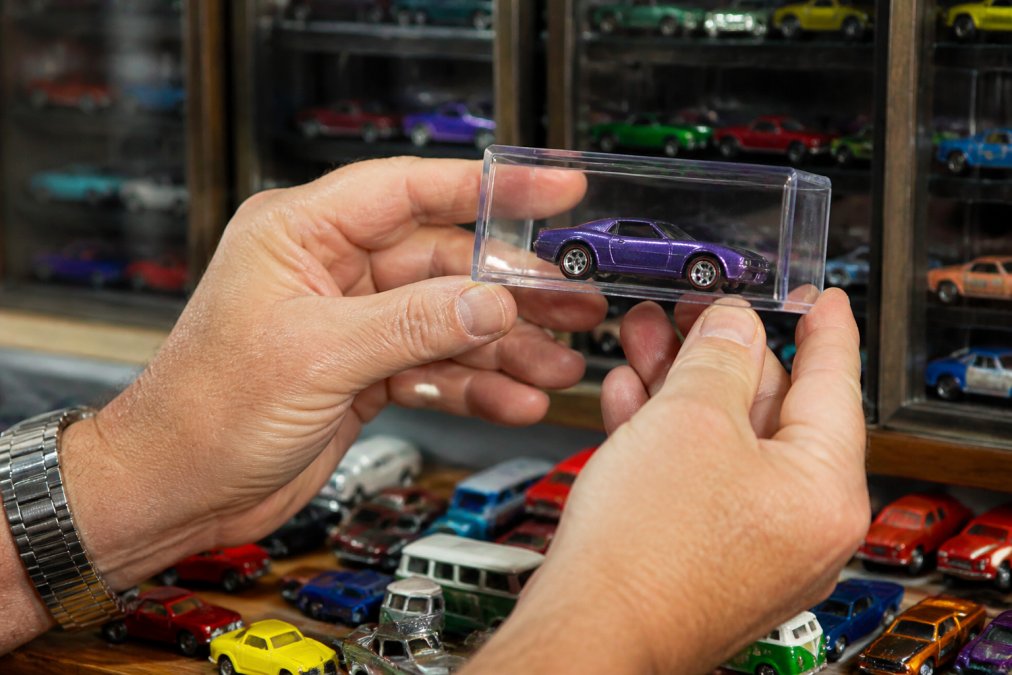
2009 Super Treasure Hunt Custom '53 Chevy. A short-printed piece anchoring the postwar kustom trilogy alongside the '49 Merc and '55 Chevy. It carries Spectraflame paint, Real Riders wheels, and the $uper TH tampo, and is genuinely hard to find sealed. Collectors who chase one often chase all three, concentrating demand on a small supply.
Why Two Identical Cars Sell for Different Prices
- Card condition. A soft corner or hairline crease can knock a meaningful percentage off the price, even when the car is untouched.
- Blister clarity. Yellowed or cloudy plastic signals age and storage problems, and buyers discount for it.
- Timing. A car appearing at auction twice a year often sells higher than one appearing twice a month, because the buyer pool has had time to build.
- Seller reputation. Documented, well-photographed listings from known sellers clear higher than anonymous listings of the same car.
To value a specific car, start with the designation, confirm the finish and wheels, then check recent sold listings for the same casting in comparable condition. Asking prices are marketing; sold prices are evidence.
Authentication and Counterfeits: Spotting Fakes Before You Buy
Counterfeits exist, and they are getting better. The most common fakes are repainted mainlines sold as Super Treasure Hunts, resealed cards, and reproduced tampos on common castings. None survive close inspection, but all catch buyers who skip the basics.
Hot Wheels 2009 Super Treasure Hunt →

Check these before you pay a premium:
- Wheel type: Real Riders are rubber. If the wheels are plastic, it is not a Super TH.
- Paint behavior: Spectraflame shifts color under angled light. A flat repaint does not.
- Tampo edges: Factory tampos are crisp and consistent. Reproduced ones look slightly soft or misregistered.
- Card seal: The blister edge should show a uniform factory seal. Lifting, cloudiness, or glue residue means it was opened.
- Card print quality: Compare the card stock and print against a known example. Fakes often use thinner stock.
- Seller history: Buy from sellers who show the card back, the seal edge, and the wheels in their photos.
Market Volatility, Storage, and Long-Term Value
Diecast prices move both ways. Market volatility is real: a casting can double when a film releases and drift back down a year later when the hype fades. Treat any single sale as a data point, not a trend. Collectors get hurt buying at the top of a hype cycle and selling at the bottom of the next.
What Actually Moves Prices
Four forces drive most of the swings you will see in this hobby:
- Media events. A film, game, or streaming release can put a dormant casting back in the spotlight overnight. Demand spikes, supply does not, and prices follow.
- Influencer and social proof. A viral post or a well-followed collector's haul video can push a casting for weeks. This is FOMO in action: buyers see others buying, assume scarcity, and bid accordingly.
- Auction dynamics. Online auctions concentrate worldwide buyers into one bidding pool. Two determined bidders can push a car past its recent comparable sales, and that result gets cited as the new market price.
- Economic climate. Discretionary collectibles soften when household budgets tighten and recover when they loosen, a general pattern that affects tiers of the hobby differently.
The FOMO Trap
The psychology of collecting drives more purchases than any spreadsheet. Completionism, nostalgia, and the thrill of the hunt push buyers past rational price ceilings, and auctions amplify all three: a countdown timer, visible bid history, and knowing another collector wants the same car create urgency unrelated to actual scarcity.
Storage and Preservation: Protecting Value Over Decades
That volatility is why storage and preservation matter as much as buying decisions. The car you buy today may be worth more or less in ten years, but its condition only degrades if you store it poorly. Preservation is the one variable you fully control.
What damages a collection:
- Ultraviolet light. Fades card printing and yellows blister plastic. Direct sun is worst; even bright indirect light adds up over years.
- Heat and humidity. Warp cards, cloud bubbles, and accelerate corrosion on metal bases. Aim for a stable, dry room.
- Weight and stacking. Crushes corners and creases cards. Store sealed cars upright, not in leaning stacks.
- Handling. Skin oils transfer to card stock and paint. Handle by the card edges only, and wash hands before touching loose cars.
- Adhesives and tape. Do not tape cards together or apply labels to card stock. Residue is permanent.
What works:
- Protective cases. Rigid plastic protectors for high-value carded cars, acid-free boxes for loose examples.
- Upright storage. Cases stored vertically, cards facing the same direction, so you can inspect without shuffling.
- Climate control. A stable indoor room away from windows, vents, and exterior walls.
- Documentation. Photograph each high-value car, note the date and source of purchase, and keep records with the collection. Provenance supports value at resale.
Buying for Investment vs. Buying for Joy
Rare Hot Wheels pricing rewards preparation, and the market does not slow down for buyers still learning the difference between a mainline and a Super Treasure Hunt.

Frequently Asked Questions
Are there any rare Hot Wheels worth money?
Yes, certain rare Hot Wheels can be worth significant money. Super Treasure Hunts, limited editions, and vintage Redline models from the late 1960s often sell for high prices due to their short production runs and strong collector demand. Error cars with factory mistakes like wrong wheels or missing tampos can also command premiums. Condition matters enormously: a carded, mint example will always outperform a loose, played-with one.
How do I tell if my Hot Wheels are rare?
Check for a TH or $uper TH logo on the card and car, Spectraflame paint, Real Riders rubber tires, and a collector number. Treasure Hunts are produced in smaller numbers than mainlines and are unannounced, so they are hard to find. Error cars, such as those with mismatched wheels or missing decals, are also rare. Research the casting name and year online to compare against known production numbers.
Do factory errors increase the value of Hot Wheels?
Factory errors can increase value, but it depends on the type and severity. Common errors like a slightly misaligned tampo may add little, while significant mistakes such as the wrong wheels, missing windows, or an incorrect body color can make a car highly sought after. Error cars are one-of-a-kind, so collector demand often pushes prices well above standard releases. Always verify the error is genuine and not post-factory damage.
Does packaging condition affect Hot Wheels resale value?
Absolutely. A factory-sealed blister pack in mint condition can double or triple the value compared to a loose car. Collectors pay a premium for unopened cards because they guarantee the car has never been played with or tampered with. Even minor creases, dents, or yellowing on the card can reduce value. For high-end pieces, professional grading of the card and blister further boosts resale potential.