

Table of Contents
- The Short Answer: What Treasure Hunts Actually Sell For
- Super Treasure Hunt vs Regular Treasure Hunt: The Value Gap
- How to Identify Hot Wheels Treasure Hunts Before You Buy
- Most Valuable Hot Wheels Treasure Hunts and What Drives Their Price
- Condition, Grading, and Authentication: Where Value Is Won or Lost
- Investment vs Hobbyist Mindset: Two Ways to Collect Treasure Hunts
- Spotting Counterfeits and Repacks Before You Pay
- Conclusion: Are Hot Wheels Treasure Hunts Worth Money to You?
- Frequently Asked Questions
Last Updated: September 30, 2026
The Short Answer: What Treasure Hunts Actually Sell For
Are Hot Wheels Treasure Hunts worth money? Yes, but far less than the hype suggests. A regular Treasure Hunt trades for a few times retail, while a Super Treasure Hunt can command $20 to $50 or more depending on casting, condition, and production run. At childrenstoycloset.com, collectors pay a premium for scarcity, not the car itself.
Super Treasure Hunt vs Regular Treasure Hunt: The Value Gap
The value gap between a Super Treasure Hunt and a regular Treasure Hunt is the biggest factor in what you pay. A regular TH sells for a modest premium over retail; a Super TH of the same casting can sell for many times that, because it is short-printed and distributed randomly inside mainline cases.
Here is how the two tiers compare:
| Feature | Regular Treasure Hunt | Super Treasure Hunt |
|---|---|---|
| Paint | Standard mainline finish | Spectraflame paint |
| Wheels | Standard plastic wheels | Real Riders rubber tires |
| Production | Short-printed | Much shorter print run |
| Tampo | TH logo | $uper TH tampo |
| Typical resale | Small premium | Premium multiple |
What Separates a $2 Mainline from a $50 Super
Three physical differences separate a $2 mainline car from a $50 Super Treasure Hunt. First, the paint: Spectraflame is a metallic, translucent finish that shifts in light and is not used on standard mainlines. Second, the wheels: Real Riders are rubber tires on premium rims, not plastic. Third, the tampo: the $uper TH logo is stamped on the car, and the packaging carries the Super TH sticker.
How to Identify Hot Wheels Treasure Hunts Before You Buy
You can identify a Hot Wheels Treasure Hunt before you buy by checking four things in order: the card, the tampo, the wheels, and the paint. A regular TH has the TH logo tampo and the green-striped Treasure Hunt card. A Super TH has the $uper TH tampo, Real Riders rubber tires, and Spectraflame paint. The card is the fastest filter because it is visible from the peg without pulling the car.
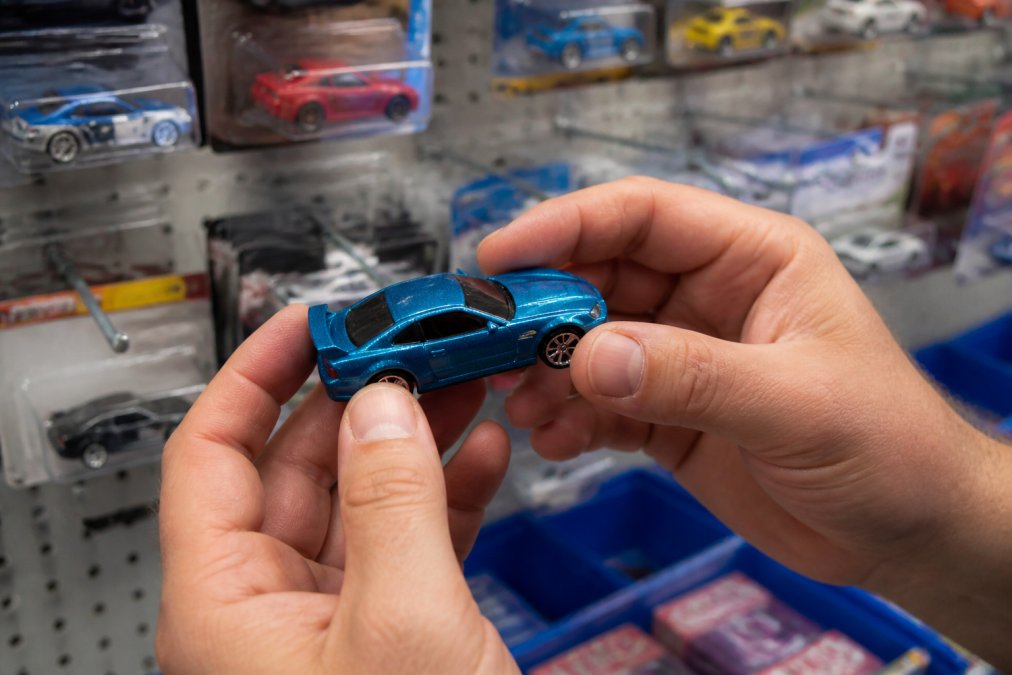
The Card Is the First Filter
Treasure Hunts ship on a card with a green stripe and the TH logo. Supers add a "Super Treasure Hunt" sticker. If the sticker is missing, the car is likely a regular TH, or someone peeled it off. That peel matters: a Super with a removed sticker loses a meaningful share of its value because the packaging no longer proves what the car is.
The Tampo, the Wheels, and the Paint: Three Tells
The tampo is the printed graphic on the car body. On a Super, it reads "$uper TH" or carries the Super Treasure Hunt logo. On a regular TH, it reads "TH" with the Treasure Hunt flame. The wheels are the second tell: Real Riders are rubber, mainline wheels are plastic. The paint is the third: Spectraflame has a depth and shift that standard metallic paint lacks.
Where to Actually Look
Identification is only half the job. The other half is knowing where Treasure Hunts surface. Supers are distributed randomly inside mainline cases, so they can appear in any store that stocks Hot Wheels: big-box retailers, grocery stores, drugstores, and dollar stores. Fresh cases yield the best odds, because the Super has not been picked yet. Ask when the store restocks, and check the pegs shortly after.
What the Card Costs You
The card matters as much as the car. A loose Super with no card loses a meaningful chunk of its value, because collectors want the packaging intact. If you are buying to hold value, buy the card; if you are buying to display, a loose car is fine and often cheaper. Decide before you pay, because the price difference is real.
Most Valuable Hot Wheels Treasure Hunts and What Drives Their Price
The most valuable Hot Wheels Treasure Hunts are not always the oldest. They are the ones with the smallest production runs, the most desirable castings, and the best condition. A 2009 Super TH of a beloved casting can outsell a newer Super TH of a car nobody wants.
Casting, Condition, and Production Run: The Three Levers
Casting is the car model itself. Iconic castings like the Bone Shaker, the '55 Chevy, and the Toyota 2000 GT carry a premium because collectors already love the shape. Condition covers the paint, wheels, card, and blister: a mint car in a sealed blister beats the same car loose with a bent card. Production run is the wild card: a shorter run means fewer examples exist, which pushes price up when demand holds.

Here is a snapshot of what we currently stock:
Hot Wheels 2013 Super Treasure Hunt →
| Model | Casting | Price | Why It Matters |
|---|---|---|---|
| 2009 Super TH Bone Shaker | Bone Shaker | $45.00 | Most recognizable casting in the lineup |
| 2009 Super TH '55 Chevy | '55 Chevy | $55.00 | Tri-Five demand, short print |
| 2013 Super TH Toyota 2000 GT | Toyota 2000 GT | $40.00 | JDM grail casting |
| 2025 Super TH '94 Bugatti EB110 SS | Bugatti EB110 SS | $40.00 | Factory sealed with sticker |
| Super TH '64 Buick Riviera | '64 Buick Riviera | $35.00 | Golden-era American design |
| 2009 Super TH '49 Merc | '49 Merc | $30.00 | Kustom culture favorite |
| 2009 Super TH '34 Ford | '34 Ford | $25.00 | Original hot rod casting |
| Super TH '63 T-Bird | '63 T-Bird | $20.00 | Classic American icon |
| 2009 TH '65 Mustang | '65 Mustang | $10.00 | Regular TH, pony car legacy |
| 2009 TH '37 Ford Woodie | '37 Ford Woodie | $10.00 | Regular TH, surf culture appeal |
Condition, Grading, and Authentication: Where Value Is Won or Lost
Condition, grading, and authentication decide whether a Treasure Hunt holds its value or loses it. A sealed blister with an unbent card and original paint is the benchmark. Once the card is creased, the blister cracked, or the paint chipped, the price drops, sometimes sharply.
Investment vs Hobbyist Mindset: Two Ways to Collect Treasure Hunts
Investment and hobbyist collecting are two different games, and mixing them is how collectors get burned. An investor buys for resale value, tracks trends, and treats the car as an asset. A hobbyist buys what they love, displays it, and does not care if the price dips next year.
The Investor's Reality Check
If you are treating Treasure Hunts as an investment, three mechanics decide whether you make money. The first is grading: professional services score diecast cars numerically, and a high grade confirms authenticity and top condition, supporting a higher price. The trade-off is cost and time, since grading fees and turnaround can eat a thin margin, so it only makes sense on cars that already command a strong price.
The Hobbyist's Advantage
The hobbyist has one advantage the investor often lacks: patience without pressure. A hobbyist can buy a car because they love the casting, keep it for years, and never check the price, removing the timing risk that sinks flippers. The trade-off is that a hobbyist who later sells may find the market has moved against them, especially on regular THs and loose cars.
Spotting Counterfeits and Repacks Before You Pay
Counterfeits and repacks are the biggest risk in the Treasure Hunt market. A repack is a genuine car resealed in a fake or reused blister. A counterfeit is a fake tampo or a repainted mainline passed off as a Super. Both look convincing in photos and fall apart under inspection.
Hot Wheels collector resources and product information
Conclusion: Are Hot Wheels Treasure Hunts Worth Money to You?
The honest answer is that Treasure Hunts are worth money, but only when you match the car to your goal. Supers with desirable castings, mint condition, and sealed packaging hold value. Regular THs and loose cars are fun to collect but rarely pay off as investments.
Frequently Asked Questions
How rare are Hot Wheels Treasure Hunts?
Treasure Hunts are short-printed by design, and Super Treasure Hunts are rarer still because they are distributed randomly inside mainline cases rather than shipped in their own case assortment. That randomness is what makes them hard to find on a peg. A regular TH might appear once in a case of 72 cars; a Super TH can be far scarcer depending on the year and casting. Scarcity, not age, is the main reason a Treasure Hunt holds value.
How much do Treasure Hunt Hot Wheels sell for?
Prices range widely based on casting, condition, and whether it is a regular or Super Treasure Hunt. At childrenstoycloset.com, factory-sealed Super Treasure Hunts start at $20 for the '63 T-Bird and run to $55 for the 2009 '55 Chevy, while regular Treasure Hunts like the 2009 '65 Mustang and '37 Ford Woodie are priced at $10. Condition, packaging, and casting popularity move the number more than the TH label alone.
What is the difference between a regular and Super Treasure Hunt?
A regular Treasure Hunt carries a TH logo tampo and collector-grade graphics on a standard mainline body. A Super Treasure Hunt adds Spectraflame paint, Real Riders rubber tires, and a $uper TH tampo, and it is short-printed and randomly inserted into cases. That combination of premium finish and lower production run is why Supers consistently trade higher than regular THs of the same casting.
How do I tell if my Hot Wheels are worth money?
Check three things: the tampo and wheels for TH or $uper TH markings, the condition of the blister card and paint, and the casting itself. Factory-sealed packaging preserves maximum collectibility, and a car kept in its blister will always outperform a loose one. Castings tied to a popular model line, like the Toyota 2000 GT or Bone Shaker, tend to hold value better than generic mainlines.
Are all Treasure Hunt cars valuable?
No. Regular Treasure Hunts are produced in larger numbers than Supers and many trade close to their retail price once the initial hype fades. Value comes from scarcity, casting demand, and condition. A short-printed Super TH in mint condition with an intact blister card will hold value; a loose regular TH with paint chips often will not. Treat the TH label as a starting point, not a guarantee.