

Table of Contents
- Why Packaging Condition Decides Diecast Value
- The Diecast Car Grading Scale Explained
- Identifying Blister Pack Damage Before You Buy
- How to Inspect Diecast Packaging: Lighting and Tools
- How to Store Collectible Diecast Cars to Protect Packaging
- How Packaging Damage Affects Market Value
- Grading vs. Authenticating: What's the Difference?
- Frequently Asked Questions
Last Updated: September 14, 2026
Why Packaging Condition Decides Diecast Value
How to grade diecast car packaging condition is the most valuable skill a collector can build, because the card and blister often matter as much as the car inside. Two identical Hot Wheels releases can sit hundreds of pounds apart purely because one has a crisp, flat card and the other a bent corner.
Condition grading is not guesswork. It follows a repeatable process, and once you learn it you can value any carded model in under two minutes.
The Diecast Car Grading Scale Explained
The diecast car grading scale is a shorthand system collectors use to describe packaging condition, ranging from Mint (factory-fresh) down to Poor (heavily damaged). Most sellers use a word grade rather than a numeric score. But words alone are not enough: two collectors can look at the same card and call it Near Mint and Excellent, which is why a visual rubric matters more than memorizing labels.
From Mint to Poor: What Each Grade Means
Here is the scale most collectors work from, applied to the packaging rather than the vehicle. Treat each grade as a band, not a precise point.
- Mint (M): Factory-sealed, no visible flaws. Card flat, corners sharp, blister clear with no dents. Under raking light, no shadow lines and the reflection is undistorted.
- Near Mint (NM): One tiny imperfection, often invisible at arm's length. A single soft corner or faint scuff that disappears under normal room light qualifies.
- Excellent (EX): Minor creasing or a soft corner, but no breaks in the seal and no blister damage. The crease may show under raking light but does not break the card's gloss.
- Very Good (VG): Visible creasing, light scuffing, or a small blister dent. Still sealed and displayable, with a corner bend obvious when tilted.
- Good (G): Obvious folds, corner bends, or discoloration. Packaging intact but clearly handled. A blister dent over the car roof or a crease crossing the artwork lands here.
- Fair (F): Tears, heavy creasing, or a cracked blister. The car may still be sealed but the packaging is compromised. Any crack or seal lift pushes the grade to Fair at best.
- Poor (P): Major damage, open or missing blister, heavy soiling. Value sits almost entirely in the car.
Card Condition vs. Blister Condition
Card condition and blister condition are graded separately because they fail in different ways. The cardboard backing takes handling, storage, and shipping abuse: bent corners, creases, discoloration. The clear plastic blister takes impact damage: dents, cracks, and separation from the card. A model can be Near Mint on the card and only Good on the blister if a dent sits over the roof line, so serious sellers list both.
A Practical Visual Rubric for Edge Cases
Most grading disagreements happen at the boundaries. Use this rubric for consistent calls:
| Situation | Likely Grade | Why |
|---|---|---|
| One soft corner, no crease lines | Near Mint | Single imperfection, invisible at arm's length |
| Crease under 1 cm that does not break gloss | Excellent | Minor creasing, seal intact |
| Crease over 2 cm or crossing artwork | Very Good | Visible creasing, still displayable |
| Blister dent over the car roof | Good | Impact damage to plastic, card may still be clean |
| Hairline crack at blister corner | Fair | Seal compromised, even if car is sealed |
| Yellowed blister with clean card | Good at best | Yellowing reads as poor storage regardless of card |
Collectors commonly over-grade their own items by one band. If unsure between two grades, ask whether the flaw is visible at arm's length under normal room light. If yes, drop one band.
Downloadable Grading Checklist
To make this repeatable, use a simple checklist. For each package, record:
- Card flatness (yes/no)
- Corner sharpness (all four corners)
- Crease length and location
- Scuffing or gloss breaks
- Blister clarity (clear/yellowed)
- Blister dents (location relative to car)
- Seal integrity (lift, crack, tape, glue)
- Discoloration or soiling
Score each item as pass, minor, or major. Two or more major items usually drops the package to Good or below. This checklist is the fastest way to grade a collection consistently.
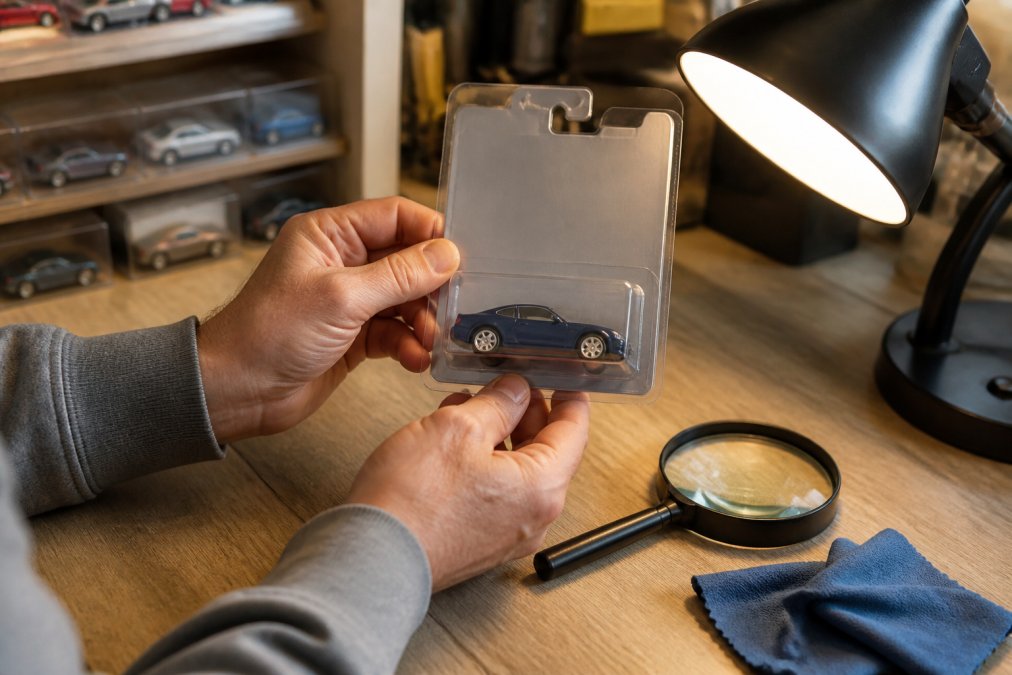
Identifying Blister Pack Damage Before You Buy
Identifying blister pack damage before purchase comes down to three checks: dents, cracks, and yellowing. Each points to a different cause and a different hit to value.
Dents, Cracks, and Yellowing
Work through the plastic in this order:
- Dents. Hold the package at a low angle to a light source. A dent shows as a distortion in the reflection, even when the surface looks smooth head-on.
- Cracks. Run your eye along the seam where the blister meets the card. Hairline cracks start at the corners and edges, where flexing stress concentrates.
- Yellowing. Compare the blister to a known-clear example. Yellowing is a chemical change in the plastic, usually from UV exposure and age, and it cannot be reversed.
- Lifting. Check whether the blister has begun to separate from the card. Any lift means the factory seal is compromised, even if the car has never been removed.
Yellowing is the most underestimated defect. A yellowed blister reads as "old and stored badly" regardless of how clean the car is, dragging the grade to Good at best.
How to Inspect Diecast Packaging: Lighting and Tools
Packaging inspection depends on lighting more than eyesight. Flat overhead light hides creases and dents; raking light from a low angle reveals them.
Set up a simple inspection station:
- A single adjustable desk lamp you can move to a low, oblique angle.
- A magnifying glass or jeweller's loupe for seam and corner checks.
- A soft microfibre cloth for dust, never for polishing card stock.
- A dark mat or cloth to place behind the blister.
- A flat, clean surface so the card is fully supported and does not flex.
Run the lamp along each card edge at roughly 15 to 20 degrees. Creases cast a shadow line; scuffing shows as a dull patch against the gloss. Then flip and repeat on the reverse, because corner bends often show worse from behind.
For a second opinion on how condition maps to value, the hobbyDB collector database is a useful reference point for how listings describe grades.
How to Store Collectible Diecast Cars to Protect Packaging
Storing collectible diecast cars correctly is the difference between a collection that holds value and one that quietly degrades. The two enemies are physical pressure and environmental exposure.
The Science of Humidity Damage
Card stock is made of cellulose fibers that absorb and release moisture. Above roughly 60% relative humidity, those fibers swell; when it drops, they shrink (Storing Works on Paper - Canadian Conservation Institute (CCI) Notes 11/2). Repeated cycles warp, cockle, and eventually delaminate the card, and mold spores already on the paper can germinate in damp conditions, leaving permanent stains.
The blister seal is also vulnerable: many use a heat-activated adhesive or crimped seal, and high humidity softens the adhesive, lifting the blister from the card even if the car was never removed. A lifted seal drops the grade to Fair regardless of how clean the card looks.
Collections stored in garages, basements, or lofts show more warping and seal lift than those in climate-controlled spaces. If you must store in a garage, use sealed plastic bins with silica gel desiccant packs, replaced every few months.
How UV Light Degrades Packaging
UV light breaks chemical bonds in plastic, causing yellowing and embrittlement in clear blisters (Smithsonian Insider - Problem plastics in museum collections have conservators on alert). The plastic becomes more brittle and likely to crack at the corners, while card print fades as UV breaks down ink pigments, especially reds and yellows.
The damage is cumulative and irreversible: a yellowed blister cannot be restored to clear. That is why UV-filtering acrylic display cases matter, blocking most damaging wavelengths while still showing the collection. Near a window, even indirect sunlight causes yellowing over months and years.
Physical Pressure and Handling
Stacking carded models flat crushes the blisters underneath and bends the cards above. Store them upright in a rigid box or case, cards vertical and slightly spaced, with acid-free backing boards to protect card edges.
Handle by the card edges only, and as little as possible; every touch adds oils and micro-scuffs. Never press a creased card flat to "improve" it; the fibers are already broken, and forcing it can crack the blister seal or lift the print.
A Practical Storage Setup
For display pieces, use a UV-filtering acrylic display box. For long-term storage, use acid-free backing boards and upright archive boxes in a room with stable temperature and humidity. Avoid radiators, hot attics, and damp basements; in humid climates, a small dehumidifier or desiccant packs in storage bins make a measurable difference over years.
The models most likely to appreciate are those still in original packaging, which is why childrenstoycloset.com ships factory-sealed cases rather than opening them for inspection.
How Packaging Damage Affects Market Value
Packaging damage affects market value on a sliding scale, not a cliff. A soft corner on a common release costs little; the same corner on a rare or chase model can cost a serious percentage, because the pool of buyers who accept a flawed example shrinks fast.
The pattern collectors see most often:
| Defect | Typical Grade Impact | Effect on Value |
|---|---|---|
| Sharp corners, flat card | Mint / Near Mint | Full market value |
| Minor shelf wear, light scuffing | Excellent | Small reduction |
| Visible creasing or soft corner | Very Good / Good | Noticeable reduction |
| Blister dent over the car | Good | Significant reduction |
| Cracked or lifted blister | Fair | Major reduction |
| Yellowed blister, heavy soiling | Poor | Value sits in the car alone |
Condition matters more on scarce castings than common ones. When hundreds of sealed examples exist, buyers pick a better one; when only a handful surface, a Very Good example may be the only one available, and it will still sell.
This is why sealed factory cases carry a premium: a model pulled from a sealed case has never been handled, so it grades at the top of the scale by default. See it on listings like this Hot Wheels Super Treasure Hunt 2025 Porsche 911 Rallye, where the factory seal is the headline feature. The same logic applies to rarer pieces: a Hot Wheels Ferrari Racer Ferrari 250 LM with a noted corner crease is priced and described honestly against a clean example.

Honest grading protects both sides of the deal: a listing stating "crease in corner" up front earns more trust than one claiming mint and shipping a bent card.
Grading vs. Authenticating: What's the Difference?
Grading and authenticating are two different jobs, and confusing them is the most common mistake in this hobby. Grading describes condition; authenticating confirms the item is genuine, unmodified, and factory-original.
A package can grade Near Mint and still be a repack: a common car resealed into a rare blister, or a reproduction card printed to look original. Grading never catches it, because the card really is flat and the blister really is clear.
Authentication checks the things grading ignores:
- Seal type. Factory seals have a consistent pattern and material. Repacks show glue lines, uneven crimping, or tape.
- Print quality. Original cards have specific fonts, colour registration, and stock weight. Reproductions are usually slightly off.
- Blister shape. Moulds differ between releases and years. A mismatched blister is a red flag.
- Casting and wheel match. The car inside must match the card's stated release.
For high-value pieces, third-party authentication services exist and their opinions carry weight in the secondary market. For everyday buying, the rule is simple: if the price looks too good for a rare sealed model, inspect the seal before the card.
If you are buying to complete a set, a seller's track record matters more than a single listing photo. childrenstoycloset.com stocks series-specific releases including Hot Wheels AcceleRacers Accelium and Mini GT x Kaido House Honda Civic EF models, and describes condition flaws openly rather than burying them in fine print.


Frequently Asked Questions
What are the standard condition grades for diecast packaging?
Most collectors use a scale from Mint to Poor. Mint means the card and blister are flawless, with sharp corners and no shelf wear. Near Mint allows minor imperfections like a tiny corner soft spot. Good shows visible creasing or scuffing but the blister stays sealed. Fair has heavy folds or dents, and Poor means tears, soiling, or a detached blister. Applying the diecast car grading scale consistently helps you compare listings and negotiate prices.
How does packaging damage affect the resale value of diecast cars?
Packaging damage can cut resale value significantly. A creased card or blister dent might drop a model by 20-40%, while tears or a detached blister can halve it. Factory-sealed examples with pristine packaging often command the highest prices on the secondary market. For rare models like Acceleracers or Fast and Furious series, even minor shelf wear matters because collectors pay a premium for collector-grade condition.
What is the difference between 'mint on card' and 'near mint' packaging?
Mint on card means the packaging is as close to factory-fresh as possible: sharp corners, no creasing, clear blister, no discoloration. Near mint allows one or two tiny flaws, such as a slightly soft corner or faint scuff, that you only notice under close inspection. The difference matters because mint examples often sell for 15-25% more than near mint, especially for sought-after castings.
What tools do I need to inspect diecast packaging condition?
You need a bright, adjustable desk lamp to catch surface flaws, a magnifying glass or jeweler's loupe for fine creases, and a soft microfibre cloth to remove dust without scratching. A ruler helps check card dimensions and corner squareness. For photographic records, use a phone with a macro lens. These tools let you apply the diecast car grading scale accurately and spot identifying blister pack damage before you buy.
Should I get my rare diecast cars professionally graded?
Professional grading makes sense for high-value models, especially rare Super Treasure Hunts or limited series. It confirms authenticity and assigns a standardized grade, which can boost buyer confidence and resale price. However, grading costs money and takes time, so it's usually not worth it for common or low-value cars. If you plan to keep the car in your collection, you can grade it yourself using the diecast car grading scale and save the fee.
Can Hot Wheels get graded?
Yes, Hot Wheels can be professionally graded, and many collectors do it for rare castings like Treasure Hunts or convention exclusives. Grading services evaluate both the car and its packaging, assigning a numeric or letter grade. The process involves shipping the item in protective packaging to avoid damage. If you're not ready for professional grading, you can still assess condition yourself using the diecast car grading scale and proper inspection techniques.
Grading packaging condition well takes practice, but the payoff is immediate: you stop overpaying for flawed models and stop underselling clean ones. Start with the scale, build a simple inspection station with one adjustable lamp, and store everything upright and out of sunlight. When you are ready to add sealed, honestly graded pieces to your collection, browse the factory-sealed inventory at childrenstoycloset.com, where every listing states its condition up front and cases ship sealed.