

Table of Contents
- Loose Super Treasure Hunts: What You Actually Give Up
- Loose vs Carded Hot Wheels: The Real Cost Difference
- How to Identify a Real Super Treasure Hunt Before You Pay
- Super Treasure Hunt Condition Grading for Loose Cars
- Super Treasure Hunt Value: What Loose Cars Actually Sell For
- Rarity vs Visual Appeal: Why Some Loose STHs Hold Up Better
- A Buyer's Checklist for Avoiding Overpaying on Loose STHs
- Conclusion: Should You Buy Loose Super Treasure Hunts?
- Frequently Asked Questions
Last Updated: October 13, 2026
Loose Super Treasure Hunts: What You Actually Give Up
Ask any collector whether loose Super Treasure Hunts are worth buying and you'll get two answers at once. Yes, because the car is the point.
Most buying guides treat loose versus carded as a cosmetic preference. It isn't.
Below, we break down what you actually give up when you buy loose, how to grade condition before you pay, and which models hold their value without the card.
Loose vs Carded Hot Wheels: The Real Cost Difference
Most comparisons stop at the sticker price. That's the wrong place to stop: the real cost difference between a loose and a carded Super Treasure Hunt is a stack of costs that only shows up after you buy.
The Card Premium, Stated Plainly
A carded STH carries a premium for three reasons: the factory sticker and blister prove the car was never opened, repainted, or wheel-swapped; the packaging protects paint and wheels in transit and storage; and the card makes resale easier because buyers don't have to trust your grading.
Loose cars trade below carded equivalents, but the discount is smaller than new buyers expect. The car is identical, same Spectraflame paint, Real Riders wheels, and casting. Only the packaging is missing, and packaging is a surprisingly large share of what collectors pay for.
The Hidden Cost Stack on a Loose Car
Here is what the sticker price does not include when you buy loose:
- Protective storage. A loose car needs a case, an acrylic holder, or at minimum a dust-free display spot. Carded cars arrive protected.
- Shipping risk. A loose car in a padded envelope can arrive with a bent axle or a chipped edge. Carded cars ship in their own protective shell. If you buy loose, you absorb that risk, and returns are often impractical.
- Authentication time. With no sticker, you verify paint, wheels, tampo, and base yourself. That is your time, and if you get it wrong, it is your money.
Add those up and the effective discount shrinks. A loose car priced 15 percent below carded is often not a 15 percent saving once you factor in a case, shipping risk, and the time spent proving authenticity to the next buyer.
When the Loose Discount Is Actually Worth It
The loose buy makes sense when the discount covers the hidden costs and still leaves you ahead:
- If the loose price is close to carded, buy carded. The premium buys you authenticity proof, protection, and resale speed for very little.
- If the loose price is meaningfully below carded and the car grades near-mint or better in daylight photos, the loose buy can be the better deal, especially if you plan to display it.
- If the loose price is far below carded but the photos are dim, the base is not shown, or the seller is vague about flaws, the discount is a warning, not a bargain. Sellers who know a car is flawed price it low to move it fast.
The Display Trade-Off
There's a real argument for loose that has nothing to do with price: a loose car is one you can actually enjoy. You can hold it, photograph it, and see the Spectraflame paint without a blister in the way.
The trade-off is converting a collectible into a display piece. That's fine if you accept it going in, and a problem if you buy loose expecting carded resale later.
How to Identify a Real Super Treasure Hunt Before You Pay
Identifying a genuine STH comes down to four checks: paint finish, wheels, tampo, and the base.
Spectraflame paint is the first tell. It has a metallic, almost mirror-like depth standard mainline paint lacks.
Real Riders wheels are the second. These are rubber tires on premium wheels, not the plastic wheels found on mainline releases.
The $uper TH tampo is the third: a small graphic, usually on the side or hood, marking the car as a chase piece.
The base is the fourth.
Super Treasure Hunt Condition Grading for Loose Cars
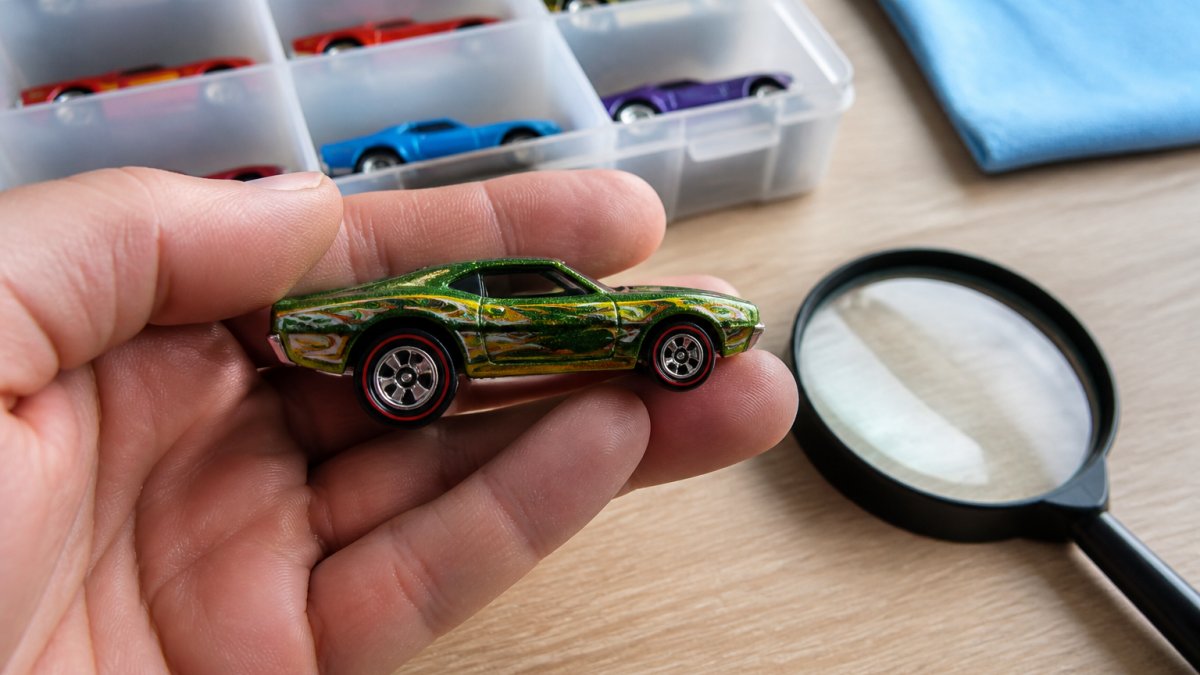
Condition grading for loose cars follows a four-tier scale most collectors recognize: mint, near-mint, good, and played-with. Once the card is gone, the grade drives price more than the model does.
What Each Grade Means for Price
Mint. No paint chips, no wheel wear, no scratches on the base.
Near-mint. One or two tiny flaws visible only under close inspection, a faint base scuff, slight wheel shine.
Good. Visible wear: edge paint chips, dulled wheels, a scuffed base.
Played-with. Heavy wear, bent axles, missing or damaged tampos.
| Grade | Visible Flaws | Price Position | Best For |
|---|---|---|---|
| Mint | None under close inspection | Near carded | Investment, display centerpiece |
| Near-mint | 1-2 tiny flaws | Moderate discount | Most collectors |
| Good | Clear wear, chips | Deep discount | Display fillers, open collections |
| Played-with | Heavy wear, damage | Minimal value | Restoration, kids, spares |
Our advice: never buy a loose STH above near-mint unless the price reflects the flaws.
Super Treasure Hunt Value: What Loose Cars Actually Sell For
The problem with pricing a loose Super Treasure Hunt is that almost every listing is an asking price, not a sold price. Sellers anchor high and relist for months, and the number you remember is the one that never moved. To judge whether a loose STH is worth buying, separate the two.
Hot Wheels 2013 Super Treasure Hunt Toyota 2000 GT Diecast Model Car →
Asking Prices vs Completed Sales
Across collector marketplaces, carded STH asking prices cluster in a band while completed sales land at the lower end or below. Loose listings show the same shape, only wider: the spread between the highest ask and lowest completed sale on the same casting often changes the buy decision entirely.
That spread exists because loose cars are priced on belief about condition. A seller who has never graded a car prices a near-mint example like a mint one; a buyer who has graded cars won't pay for it.
How to Read Sales History Without Getting Fooled
When you look at recent completed sales for a specific casting, filter for four things:
- Same casting and year. A 2024 STH and a 2025 STH of the same model are different markets. Do not average them.
- Same packaging state. Carded sales tell you the ceiling. Loose sales tell you the floor. Mixing them produces a number that describes nothing.
- Photo quality. Listings with daylight photos and base close-ups sell closer to true condition value. Listings with one dim photo sell lower because buyers discount for the unknown.
A practical rule: pull three to five completed loose sales of the same casting in comparable condition, drop the highest and lowest, and treat the middle as your reference. If the seller's price is more than a modest margin above that middle, you're paying for the seller's optimism.
Why Liquidity Matters More Than the Last Sale
A single high sale doesn't make a car valuable, it makes one buyer generous. What matters for a loose STH is how many buyers actively want that casting without the card.
Cars with a fanbase outside the chase market, JDM icons, golden-era American designs, movie and pop-culture castings, have a deeper pool of loose buyers because people want the car, not the sticker.
What This Means for Your Buy Decision
If completed loose sales for the casting you want sit close to carded sales, buy carded, you're paying a small premium for authenticity proof, paint protection, and faster resale. If they sit meaningfully below carded and the photos show a car you'd grade near-mint or better, the loose buy can make sense, especially if you plan to display rather than flip it.
The mistake to avoid is treating a high asking price as evidence of value. Asking prices are opinions. Completed sales are data. Buy on the data.
Rarity vs Visual Appeal: Why Some Loose STHs Hold Up Better
Rarity and visual appeal are different forces, and loose cars expose the gap.
Manufactured scarcity is the term: Super Treasure Hunts are intentionally produced in limited quantities and inserted randomly into cases.
Three factors decide whether a loose STH holds up:
- Casting popularity. Models with a fanbase outside the chase market, like JDM icons and golden-era American designs, retain value loose.
- Paint and tampo quality. Spectraflame finishes that photograph well hold attention. Dull or uneven finishes don't.
- Display appeal. A car that looks good on a shelf without its card will always find a buyer.
The '64 Buick Riviera is a useful example. It's a golden-era American design with sweeping lines that display beautifully, and the STH treatment adds Spectraflame paint and Real Riders tires.

A Buyer's Checklist for Avoiding Overpaying on Loose STHs
Run this checklist before paying for any loose Super Treasure Hunt. It takes two minutes and prevents the hobby's most expensive mistakes.
- Confirm Spectraflame paint under daylight, not indoor lighting
- Check for Real Riders rubber tires, not plastic mainline wheels
- Verify the $uper TH tampo is present and undamaged
Conclusion: Should You Buy Loose Super Treasure Hunts?
Buy loose Super Treasure Hunts if you display your cars, know how to grade condition, and the discount is meaningful. Buy carded if you're investing, reselling, or buying a model you can't inspect in person.
For most collectors, the card is worth more than the discount, especially on desirable castings. Our inventory covers Hot Wheels Super Treasure Hunts, Acceleracers, Fast and Furious, and Retro Entertainment series, shipped factory sealed so the condition you buy is the condition you receive.
If you want a loose car for your display shelf, buy it with clear eyes and a graded price. If you want a piece that holds its value, buy it sealed.
Frequently Asked Questions
Are loose Super Treasure Hunts worth less than carded ones?
Yes, typically 30-50% less. A carded STH retains its factory seal, original packaging, and verified authenticity, which most collectors pay a premium for. A loose car loses that packaging premium but keeps its casting, paint, and wheels. If you plan to resell later, carded usually recovers more. If you want to display or handle the car, loose gives you the same casting for less money.
How can you tell if a loose Hot Wheels Super Treasure Hunt is authentic?
Check three things: Spectraflame paint (metallic, reflective, not flat), Real Riders rubber tires (not plastic wheels), and the TH logo tampo on the body. Also compare the casting to known mainline versions. A loose STH should have premium details that a standard mainline car does not. If the paint looks flat or the wheels are plastic, it is likely a mainline car, not a Super Treasure Hunt.
What should I check before buying a loose Super Treasure Hunt?
Inspect for paint chips, scratches, bent axles, and wheel damage. Ask for close-up photos from multiple angles. Check if the car rolls smoothly. Look for any signs of touch-up paint or replaced wheels. If buying online, confirm the seller's return policy. A loose STH in poor condition can lose most of its value, so condition matters as much as authenticity.
Do loose Super Treasure Hunts hold their value?
They hold value but not as well as carded examples. Loose STHs from sought-after castings like the Toyota 2000 GT or '73 Honda Civic Custom still sell well because the casting itself is desirable. However, loose cars are more vulnerable to condition issues over time. If you store them properly in cases or protectors, they retain most of their value. Carded examples generally appreciate faster.
Can a loose Super Treasure Hunt be a good choice for a beginner collector?
Yes. Loose STHs let beginners own rare castings at a lower entry price. You get the same Spectraflame paint and Real Riders wheels without paying the carded premium. Start with a casting you actually like, inspect it carefully, and store it in a protector. As you learn more about condition grading and market values, you can decide whether to upgrade to carded examples later.
The loose-versus-carded decision gets easier once you stop treating the card as packaging and start treating it as proof. Childrenstoycloset.com stocks factory-sealed Super Treasure Hunts across Hot Wheels, Disney Cars, Greenlight, and Auto World, with sealed shipping that protects the sticker, the blister, and the paint. Browse the collection, find the casting you've been hunting, and buy with the condition guaranteed rather than hoped for.