

Table of Contents
- Why Series Searching Beats Keyword Hunting
- The Best Way to Search Diecast by Series: 5 Steps
- How to Identify Diecast Car Series Without Guessing
- What to Look For in the Best Online Stores for Diecast Cars
- Series Worth Searching For Right Now
- Frequently Asked Questions
Last Updated: September 17, 2026
Why Series Searching Beats Keyword Hunting
Typing a model name into a search bar and hoping the right listing appears is the slowest way to shop for diecast. Series searching flips that: you search by manufacturer series, set number, and release year, which narrows thousands of listings down to the exact run you're collecting.
Below, we'll show you exactly how to search diecast by series in five repeatable steps, plus how to identify a series when the listing gives you almost nothing to work with.
The Best Way to Search Diecast by Series: 5 Steps
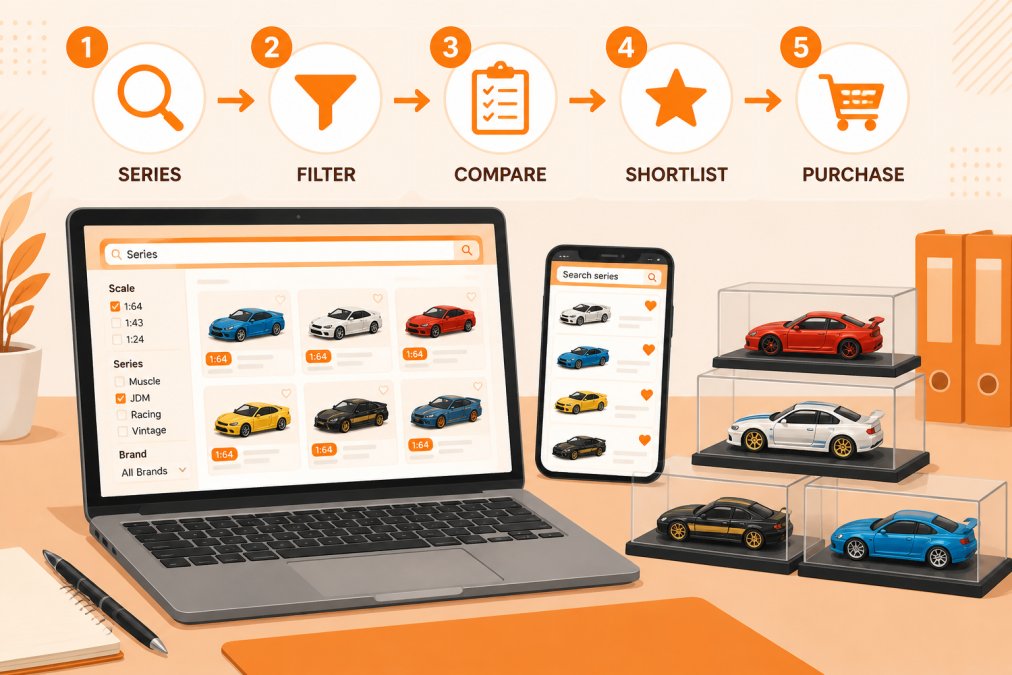
The best way to search diecast by series is to combine three inputs: the exact series name, the release year, and the set number, then run that combination across multiple platforms instead of one.
Here's the five-step process, in order. Each step includes the specific search syntax and filter mechanics that separate a five-minute find from a five-hour hunt.
| Step | What You Do | Time Per Search | How Often |
|---|---|---|---|
| 1 | Decode the series name, set number and year using manufacturer codes | 2-3 min | Every new hunt |
| 2 | Build a Boolean query string with operators and run it on retail sites | 5 min | Per platform |
| 3 | Aggregate the same query across auction sites, forums and databases | 10 min | Weekly |
| 4 | Verify factory-sealed condition and cross-check the SKU | 3 min | Per listing |
| 5 | Log the find in a collection tracker with series metadata | 2 min | Per purchase |
Step 1: Decode the Series Name, Set Number and Release Year
Get the series name exactly right before you search anything. "Larry's Garage" and "Wayne's Garage" are not interchangeable, and a wrong series name sends you into a completely different production run.
Standardized nomenclature matters here, and this is where most collectors lose time. Diecast manufacturers use inconsistent naming conventions across lines, so you need to decode the series code before you can search it effectively. Hot Wheels, for example, often embeds the series name, a set number in the format "X/Y" (where X is the car's position and Y is the total run size), and the casting name on the packaging. A listing for the Hot Wheels Wayne's Garage 28/39 '71 El Camino Black & Gold tells you the series, the position in the run (28 of 39), and the subject car. Search all three, not just the car name.

Other manufacturers use different patterns. Greenlight often uses a series name plus a release year and a numeric code (e.g., "Greenlight Hollywood Series 32"). Auto World uses a series name and a car number. Matchbox uses a series name and a collector number. The key is to identify the pattern for the brand you're chasing, then extract the three searchable tokens: series name, set number, and year.
Step 2: Build a Boolean Query String and Use Advanced Filters
Most collectors never touch the filters or use search operators. That's a mistake, because the filter panel and Boolean logic are where series-specific search actually happens.
Start by building a reusable query string. Use quotation marks to lock exact phrases, the minus sign to exclude noise, and parentheses to group alternatives. For example:
"Larry's Garage" "14/20" -custom -loose
This tells the search engine to find listings that contain the exact series name and set number, but exclude custom or loose items. You can also use OR to catch alternate spellings: "Larry's Garage" OR "Larrys Garage" "14/20".
On retail sites, filter by brand, series and scale before you type anything. On auction sites, use the category tree to reach the diecast section, then apply condition and year filters. A search for "Hot Wheels" alone returns thousands of results; a search filtered to a single series returns a handful.
The Hot Wheels Larry's Garage 14/20 T-Bucket in black is a good example. Searching "T-Bucket" alone buries it under every hot rod casting ever made. Searching "Larry's Garage" "14/20" puts it on the first screen.

Step 3: Run Cross-Platform Search Aggregation
No single platform carries a full series. Cross-platform aggregation means running the same query string across multiple platforms and comparing results.
Hot Wheels Wayne's Garage 28/39 '71 El →
Build one search string per series and reuse it everywhere. For example: "[series name]" "[set number]" [year] 1:64 -custom. Paste that into each platform's search bar, then bookmark the results page so you can recheck it weekly.
But don't stop at the big marketplaces. Dedicated diecast databases and collector wikis often have more accurate series metadata than general retail sites. Sites like the Hot Wheels Wiki or Greenlight collector databases let you search by series name and see the full run, including variations and release years.
Step 4: Verify Factory-Sealed Condition and Cross-Check the SKU
Factory-sealed is the only condition that protects your investment. A "mint" car in an opened box is worth less than the same car still sealed, and repackaged items are common enough that you should assume nothing.
Step 5: Log Every Find in a Diecast Car Collection Tracker
A diecast car collection tracker is what stops you buying the same car twice and shows you exactly which numbers you're still missing from a run.
How to Identify Diecast Car Series Without Guessing
Identifying a diecast car series comes down to four clues: the packaging text, the set number, the casting details and the release year. Cross-check at least two before you commit to a purchase.
What to Look For in the Best Online Stores for Diecast Cars
The best online stores for diecast cars share three traits: series-level search, honest condition grading and reliable shipping of sealed product. Everything else is secondary.
- Series search or filter: you should be able to browse by series, not just by brand
- Factory-sealed guarantee: the listing should state the condition clearly
- Protective packaging: cases and cards need rigid protection in transit
- Restock visibility: you want to know when hard-to-find models return
- Clear return policy on damaged items: accidents happen, and the policy should say what happens next
Series Worth Searching For Right Now
Not all series reward series-level searching equally. The ones that do tend to share three traits: they have a defined set number (so you can search by position), and they have limited distribution (so keyword search buries them).
How to Spot a High-Value Series
Start with the set number. If a series has a defined run size, like "28/39" or "10/30", it's a closed set. Closed sets are easier to search because you can target the exact number you're missing. Open-ended series (like mainline Hot Wheels) don't have a set number, so series search is less effective.
Current Series That Fit the Pattern
The Hot Wheels Garage line is a strong example. The Hot Wheels Garage '65 Chevy Impala in pink is a display centrepiece, and Garage Series releases tend to be limited enough that series search beats keyword search every time. The series has a defined run and a set number, so you can search by position.

How to Apply the Search Method to Any Series
Once you've identified a series worth searching, apply the five-step method from earlier. Decode the series name and set number, build a Boolean query string, aggregate across platforms, verify condition and SKU, and log your finds.
Frequently Asked Questions
Is there a diecast collector app for tracking a collection?
Yes. Most collectors use a spreadsheet or a dedicated diecast car collection tracker app to log series name, release year, scale, SKU and condition. A tracker matters most when you search diecast by series across several shops, because it stops you buying the same casting twice. Log the series number, such as 28/39 in a Larry's Garage run, so you can see at a glance which pieces are still missing.
How do I identify a diecast car by its series?
Start with the packaging. Carded and boxed releases print the series name, the piece number within the run and often the collector SKU on the back or base. If the card is gone, check the base of the model for the casting name and year, then match the colourway against a series checklist. Learning how to identify diecast car series this way takes minutes and prevents paying premium prices for a mainline casting.
What are the most sought-after diecast car series?
Premium adult lines with short production runs draw the most attention. Hot Wheels Car Culture, Retro Series Entertainment, Pop Culture sets and themed collections such as Fast and Furious and Larry's Garage all have dedicated followings. Sets are often easier to complete in one purchase than piece by piece. Rarity comes from the production run, not the brand name alone.
How do I find the value of diecast cars before I buy?
Check completed sales rather than active listings, since asking prices are often inflated. Compare the same casting, colourway and series number in matching condition. Factory-sealed examples with unopened packaging hold more value than loose models, and condition grading affects price significantly. Build a short list of recent sales for the series you want, then set a ceiling price before you start searching so you do not overpay in the moment.