

Table of Contents
- What to Look For When Buying Vintage Hot Wheels Online: The Basics
- How to Identify Vintage Hot Wheels Before You Buy
- How to Tell If a Hot Wheels Car Is Rare
- Hot Wheels Car Condition Grading: Loose, Carded, and Mint-in-Box
- Vintage Hot Wheels Value Guide: Price Research and Fair-Value Assessment
- Authenticity Checks: Reproduction and Altered-Car Warning Signs
- Seller Reliability, Returns, and Buyer Protection
- Conclusion: Building a Buying Checklist That Protects Your Collection
- Frequently Asked Questions
Last Updated: October 7, 2026
What to Look For When Buying Vintage Hot Wheels Online: The Basics
Buying vintage Hot Wheels online comes down to five checks: casting and base codes, production era, condition grade, authenticity, and seller trust.

This guide walks through the inspection process, from reading a base code to judging a seller's return policy.
Below, we'll show you how to inspect a listing photo by photo, what a fair price looks like, and which questions to ask before you pay.
How to Identify Vintage Hot Wheels Before You Buy
Identifying a vintage Hot Wheels car means reading the base, matching the casting to its release year, and checking the wheels against the era. A listing that shows none of these details is a listing you should skip.
Start with the underside. The base tells you more than any seller description ever will.
Reading the Base: Model Name, Casting, and Country of Origin
The base of a Hot Wheels car carries the model name, the casting name, the copyright year, and the country of manufacture. Compare all four against the seller's claim before you bid.
A few things to check:
- Model name stamped or raised on the base
- Copyright year, which is the design year, not always the release year
- Country of origin, which changed over the decades
A common mistake is treating the copyright year as the production year. They often differ by a year or more, and sellers lean on that gap to inflate a car's age.
Production Date and Era: Redlines, Mainlines, and Treasure Hunts
Production era decides most of a car's value. Redline era cars from the late 1960s and early 1970s sit at the top, followed by later premium sub-series such as Treasure Hunts and Neo Classics.

Era matters because it sets both rarity and demand. A Redline with original wheels and paint draws far more interest than a later mainline in the same condition.
How to Tell If a Hot Wheels Car Is Rare
A Hot Wheels car is rare when it was short-printed, part of a limited sub-series, or carries a documented variation or error. Rarity is not the same as age, and plenty of old cars are common.
Three signals do most of the work:
- Short production runs, such as premium sub-series releases
- Documented variations, including wheel, paint, or tampo differences
- Factory errors, such as missing or misapplied decals
Demand matters as much as supply. A rare casting nobody wants sells for less than a common casting everyone is chasing.
Hot Wheels Car Condition Grading: Loose, Carded, and Mint-in-Box
Condition grading sorts a car into one of three states: loose, carded, or mint-in-box. Each state has its own checklist, and the gap in value between them is often larger than the gap between two similar castings.
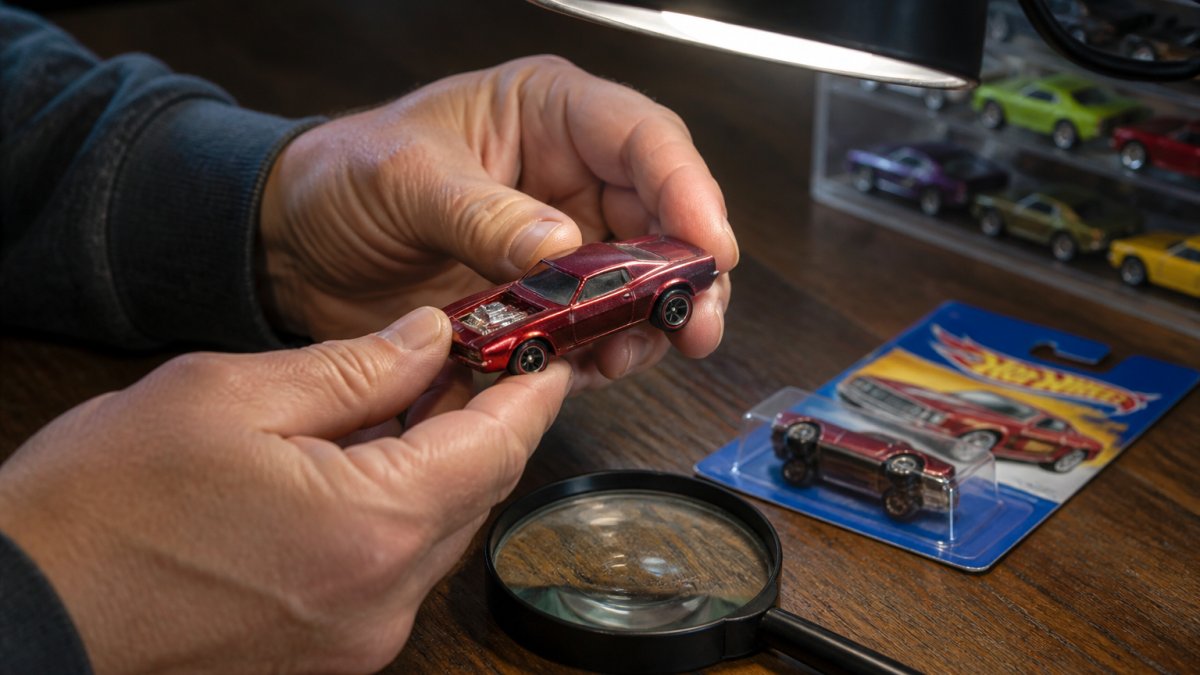
Because you cannot tilt the car under a lamp or run a fingernail along the edge of a decal, online grading depends on what the listing photos actually show. Use this photo-by-photo inspection checklist before you bid.
Loose Cars: What to Inspect in the Photos
For a loose car, request and study these specific shots:
- Base, straight-on and in focus, confirms the casting name, copyright year, and country of origin, and reveals corrosion, scratches, or a base that does not match the body.
- Both sides in daylight, shows paint chips, scuffs, and whether the finish is even or touched up.
- Wheels and axles, close up, look for bent or rusty axles, flat-spotted tires, and wheels that do not match the casting's known releases.
A common pattern is a seller who photographs the car on a bright background from one angle only. That framing hides base damage and repaint, so treat a single-angle listing as a reason to ask for more photos, not a reason to bid.
Carded Cars: Reading the Card, Not Just the Car
For a carded car, the card is half the value. Check:
- Card creases and bends, a hard crease across the middle or a bent corner drops the grade even if the car is perfect.
- Corner wear and edge fraying, soft, fuzzy corners indicate handling and storage wear.
- Punch tab, an unpunched hanger tab is a stronger sign of an unplayed-with car than a punched one.
Ask for a photo of the card back as well. The back often carries the release year, the assortment number, and the country of manufacture, which you can cross-check against the car.
Mint-in-Box: Verifying a Seal You Cannot Touch
For mint-in-box items, the seal is the whole game. Request:
- A straight-on shot of every sealed edge, corners and flaps are where seals fail.
- A photo of the box corners, crushing and shelf wear show up here first.
- A shot under raking light, angled light reveals dents, water stains, and storage marks that flat lighting hides.
If the seller will not photograph the seal, assume the seal is compromised. A resealed box is not a mint-in-box car, and the price should reflect that.
Hot Wheels 2009 Super Treasure Hunt Bone Shaker Diecast Model Car →
| Grade | What to Check in Photos | Typical Impact |
|---|---|---|
| Loose | Base, both sides, wheels, axles, missing parts | Lowest value, easiest to inspect |
| Carded | Card creases, corners, punch tab, bubble, tape | Mid value, card condition drives price |
| Mint-in-box | Seal edges, box corners, raking-light dents | Highest value, hardest to verify online |
Vintage Hot Wheels Value Guide: Price Research and Fair-Value Assessment
Fair value comes from completed sales, not asking prices. Filter a marketplace by sold listings, then compare at least five recent sales of the same casting in a similar grade.
Work through these steps:
- Search the exact casting name and year
- Filter to sold or completed listings only
- Match the condition grade to your target car
- Note the range, not a single number
- Discount for any flaw the seller admits to
Asking prices tell you what sellers hope for. Sold prices tell you what buyers actually paid, and the two can sit far apart.
Authenticity Checks: Reproduction and Altered-Car Warning Signs
Repaints, wheel swaps, and reproduction decals are the three most common fakes in the hobby. Each one can turn a common car into a listing that reads like a rare find.
Watch for these red flags:
- Paint that looks too glossy or too even for the era
- Wheels that do not match the casting's known releases
- Decals with sharp modern edges or wrong colors
Compare the car against a known original whenever you can. A side-by-side photo check catches most alterations before money changes hands.
Seller Reliability, Returns, and Buyer Protection
Seller reliability decides whether a good deal stays good. Check feedback history, return terms, and payment protection before you commit, not after the parcel arrives. This is the part of online buying that most guides skip, and it is where the money is actually lost.
Vetting the Seller Before You Bid
Work through these checks in order:
- Feedback history, not just the score, read the last twenty or so reviews for patterns. A single recent negative about packing or misdescription matters more than a high lifetime percentage.
- Are the photos the seller's own?, reverse-image search a photo or two. Stock images and reused photos from other listings are a red flag.
- Does the seller specialize in diecast?, a seller with a track record in Hot Wheels usually knows how to grade and pack a car; a general reseller often does not.
Questions to Ask Before You Pay
Send these in one message so the seller can answer them together:
- Can you send a straight-on photo of the base and a close-up of the wheels and axles?
- Is the car original, or has it been repainted, retaped, or had parts swapped?
- Are the photos your own, and are they of the exact car I will receive?
- What is the return window, and who pays return shipping if the car is not as described?
- How will the car be packed, and will it be shipped tracked and insured?
A seller who answers all five clearly is usually a safer bet than one offering a lower price with vague terms. A seller who dodges the base and wheel questions is telling you something.
Payment Methods and Buyer Protection
Pay through a method that carries buyer protection, such as a platform checkout or a payment service with a dispute process. Direct bank transfers and gift-card payments leave you with no recourse if the car arrives damaged or is not what was listed.
Keep the listing page, the photos, and the message thread until the car arrives and you have inspected it. If you need to open a dispute, that record is your evidence.
Shipping and Damage Prevention
Vintage Hot Wheels are small, light, and easy to damage in transit, especially carded cars where a bent corner destroys the grade.
- Ask for rigid protection, a carded car should ship between stiff cardboard or in a card-backed mailer, not loose in a padded envelope.
- Request tracking and insurance on anything valuable. Untracked shipping is a gamble you do not need to take.
- Photograph the parcel before opening if the box arrives crushed, and film the unboxing for high-value cars. This is standard practice among collectors and makes a damage claim straightforward.
For collectors who want sealed stock and consistent condition, buying from a specialist retailer removes most of this guesswork.
Conclusion: Building a Buying Checklist That Protects Your Collection
Online buying rewards patience and a repeatable process. The collectors who avoid bad deals are the ones who check the base, grade the condition, verify sold prices, and vet the seller every single time.
Our inventory covers Hot Wheels, Disney Cars, Greenlight, and Auto World, including series like Acceleracers, Fast and Furious, and Retro Entertainment. Every item ships factory sealed, so the condition you order is the condition you open.
Start with our Hot Wheels 2009 Super Treasure Hunt Bone Shaker Diecast Model Car, a short-printed piece with Spectraflame paint and Real Riders wheels. Or browse the Hot Wheels 2005 T-Hunt 1967 Camaro Diecast Model Car if vintage Treasure Hunts are your focus.

Frequently Asked Questions
How do I check if my Hot Wheels is rare?
Start with the base of the car: the model name, casting, production year, and country of origin are stamped there. Cross-reference the casting against collector databases and recent sold listings. Treasure Hunt and Super Treasure Hunt releases, short-printed castings, and factory errors carry the most demand. A 2009 Super Treasure Hunt Bone Shaker with Spectraflame paint and Real Riders wheels, for example, sits at the top of the collector tier because it was short-printed and is still heavily sought after. Rarity alone does not set price; demand does.
How can I tell if a vintage Hot Wheels car is authentic?
Look for casting details that match the original release: correct base stamping, correct wheel type, and tampo placement consistent with the era. Reproductions often have softer casting lines, slightly wrong paint tones, or wheels that do not match the period. Ask the seller for close-up photos of the base, wheels, and axles before buying. If a price looks far below what the same casting sells for elsewhere, treat that as a warning sign rather than a bargain.
How do I assess the condition of a vintage Hot Wheels car from online photos?
Request photos from multiple angles in natural light: front, back, base, wheels, and any card or box edges. Check for paint chips, scratches, bent axles, wheel wear, and yellowing on the card. Loose cars should be graded on paint, wheels, and completeness; carded cars need the card, blister, and any original parts intact. If the seller only shows one flattering angle, ask for more before you commit.
What questions should I ask a seller before buying vintage Hot Wheels online?
Ask whether the car is loose, carded, or mint-in-box; whether it has been repainted or had parts swapped; whether the photos are of the actual item; and what the return policy covers. Also ask how the car will be packed for shipping, since bent axles and crushed cards are common damage points. A seller who answers clearly and provides extra photos is usually a safer bet than one who avoids specifics.
Buenas tardes estoy interesado en la compra de autos de forma mayorista es decir por cantidad , queria saber si los precios que figuran son por compra unitaria y si compro cantidad tengo algun descuento adicional , soy de argentina ,tengo un deposito de recepcion en doral florida.
Aguardo su respuesta , gracias