

Table of Contents
- Diecast Collecting in 2026: What Has Changed
- How to Spot a Super Treasure Hunt Car
- Best Diecast Brands for Investment
- Diecast Car Storage and Display Ideas That Protect Value
- Authentication, Grading and Insurance Documentation
- Where to Buy Diecast Models in 2026
- Common Diecast Collecting Mistakes to Avoid
- Frequently Asked Questions
Last Updated: September 15, 2026
Diecast Collecting in 2026: What Has Changed
Diecast collecting in 2026 looks different from even three years ago. Factory-sealed cases now command a real premium, and collectors who understand production runs are pulling ahead of impulse buyers.
The old rules still matter: know your scale, series and storage. What's changed is the speed, forums surface a new release within hours, and the window to buy at retail price closes fast. Below, we break down the checks, brands, storage methods and buying habits that separate a collection that appreciates from a shelf of loose cars.
How to Spot a Super Treasure Hunt Car
Spotting a super treasure hunt car comes down to three things: paint finish, wheels and logo. Regular Treasure Hunts use a standard finish and a small flame logo. Super Treasure Hunts use spectraflame paint, Real Riders rubber tires, and the same logo on a premium card. Miss one check and you are likely looking at a mainline car.
Paint, Wheels and the TH Logo: The Three Checks
Start with the paint. Spectraflame has a metallic depth standard enamel lacks, especially under direct light. Tilt the car and watch for a color shift.
Next, check the wheels. Rubber tires with tread detail mean Real Riders, which only appear on premium and Super Treasure Hunt releases (Hot Wheels x Formula 1 Partnership and Products). Plastic wheels rule it out.
Finally, find the logo. The circular flame logo sits on the card and often on the car itself. On a genuine Super, the card is premium stock with a thicker backing.
- Paint has metallic spectraflame depth
- Wheels are rubber with visible tread
- Flame logo present on card and casting
- Card stock is premium, not thin mainline
A common mistake is buying a loose car with no card and assuming it is a Super, without the card, you cannot verify the release. For a factory-sealed option, the Hot Wheels Premium Car Culture Thrill Climbers 2026 Factory Case keeps the contents untouched, which matters when chasing a variant.

Best Diecast Brands for Investment
The best diecast brands for investment in 2026 combine limited production runs, documented series and an active secondary market. Brand alone does not decide value, the line, production run and condition do. Here is how the major brands break down.
Hot Wheels leads on volume and resale activity. The lines that matter for investment have documented production runs and premium construction: Car Culture, Boulevard, Premium Collector Sets and RLC (Red Line Club) releases. Mainline cars are mass-produced and rarely appreciate. A sealed Car Culture case or an RLC release with a known production number is a different asset class entirely.
Greenlight appeals to detail-focused buyers who want scale accuracy and licensed castings. Its "Hollywood" and "Running on Empty" series have dedicated followings, and sealed cases hold value better than opened ones because the packaging is part of the collectible.
Auto World targets the scale-accuracy crowd with 1:64 and 1:18 releases that often include opening hoods and detailed engines. Production runs are smaller than Hot Wheels mainline: less volume, but also less liquidity, so you may wait longer for a buyer.
Johnny Lightning and M2 Machines sit in a similar tier: niche, detail-oriented and dependent on a specific collector community. M2's "Auto-Thentics" and "Detroit Muscle" lines are most often traded sealed.
Disney Cars holds a different kind of value, driven by character fans rather than speculators. Commemorative and anniversary releases hold better than standard character cars because the packaging and occasion create a defined production window.
What Actually Drives Resale Value in 2026
Four factors separate a car that appreciates from one that sits:
- Production run size. A documented run of a few thousand units behaves very differently from an open-ended mainline run. If the manufacturer does not publish a number, treat the piece as mass-produced.
- Sealed condition. Factory-sealed cases and unopened cards command a real premium in 2026. The moment the seal breaks, the piece drops a price tier.
- Series completion demand. Collectors chasing a full set pay more for the last missing piece than for a random single. Series with a defined checklist, Car Culture, Boulevard, M2 Auto-Thentics, create this dynamic.
- Licensing and character appeal. A licensed casting of a recognizable car or character reaches a wider buyer pool than a generic design, shortening time to sell.
Resin vs Diecast: Which Holds Value Better
Resin models usually win on detail. Diecast models usually win on durability and resale activity.
Resin castings capture fine panel lines and thin parts that diecast manufacturing struggles to match, but they are fragile: resin chips and cracks, and does not tolerate heat or direct sunlight (pubmed.ncbi.nlm.nih.gov). Diecast chassis hold up better to handling and shipping, which is why most active collectors still trade in diecast.
| Factor | Resin | Diecast |
|---|---|---|
| Detail level | Higher, finer parts | Good, sturdier parts |
| Durability | Fragile, chips easily | Handles handling well |
| Resale activity | Niche, slower | Broad, faster |
| Best for | Display-focused collectors | Active buyers and traders |
For most collectors building a collection they will handle and trade, diecast is the safer base. Add resin pieces when you want a specific casting and can store it properly.
Diecast Car Storage and Display Ideas That Protect Value
Diecast car storage and display ideas that protect value start with three rules: block UV light, control dust, and keep packaging intact. Paint fades under direct sunlight, and dust settles into panel gaps where it is hard to remove without scratching (pubmed.ncbi.nlm.nih.gov).
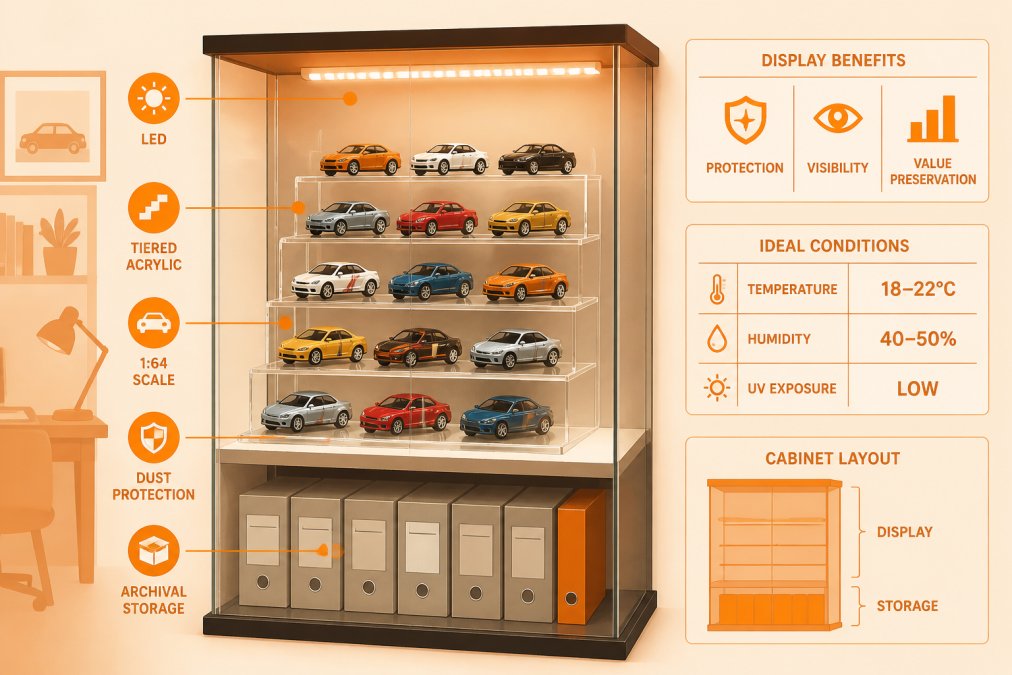
Display cabinets with glass doors beat open shelving. Add UV protection film if the cabinet sits near a window, and use cool LED strips rather than heat-throwing halogen. Keep the lights off when not viewing the collection.
Store loose cars in archival sleeves or acid-free boxes. Keep sealed cases sealed. Once you open a factory case, the contents lose the condition premium that buyers pay for.
Authentication, Grading and Insurance Documentation
Authentication and grading turn a pile of cars into an insurable collection. Most guides stop at "get it graded" without explaining how grading works, how to spot a counterfeit or how to file a claim. This section covers all three, because in 2026 the re-boxed counterfeit problem is the biggest pain point for serious collectors.
How Model Car Grading Actually Works
Grading services evaluate a car across four areas: paint and finish, casting integrity, packaging condition and originality. Each is scored, and the combined score places the car in a grade tier. A graded car in mint condition with original packaging is easier to sell and insure than a loose one, because the grade is an independent third-party record of condition.
What graders look for:
- Paint and finish. Orange peel, runs, fading, and touch-ups all lower the score. Spectraflame and other premium finishes are checked for color shift consistency.
- Casting integrity. Bent axles, warped bases, and stress cracks in the body are noted.
Spotting Re-Boxed and Counterfeit Models
Documenting Your Collection for Insurance
A practical documentation workflow:
A graded, documented car in original packaging sells faster and insures cleaner than the same casting loose. Grading is not just for resale; it is your proof of condition, and your documentation is what turns that proof into a payout.
Where to Buy Diecast Models in 2026
Common Diecast Collecting Mistakes to Avoid
Frequently Asked Questions
Will diecast models increase in value in 2026?
Some do, most do not. Value climbs when a casting is limited, factory sealed and in demand years later. Sealed cases, chase pieces and short production runs hold value best, while open, played-with mainline cars usually sell for close to retail on the second-hand market. Treat diecast collecting as a hobby first and an investment second, and buy pieces you would keep either way.
How do I spot a Super Treasure Hunt car?
Check three things: a Spectraflame paint finish that shifts in light, Real Riders rubber tires instead of plastic wheels, and a small TH flame logo printed somewhere on the body. The card also carries a gold circle behind the car. If the wheels are plastic or the paint looks flat, it is the standard version, not the Super Treasure Hunt.
What is the best diecast scale for beginners?
Start with 1:64 scale. It costs the least per car, takes up little shelf space, and covers Hot Wheels, Disney Cars and most premium lines. Move to 1:18 scale later if you want opening doors and detailed engines, but expect to pay more and need far more display room for each model.
How should I store my diecast collection to maintain value?
Keep models in their original packaging with the card and blister intact, since packaging integrity drives resale value. Store boxes upright in acid-free or archival sleeves, away from direct sunlight and damp rooms, and use UV protection on any display cabinet. Dust the shelf, not the car, and avoid touching paint with bare fingers.
Diecast collecting rewards patience and condition, not speed. The collectors who protect their packaging, control their storage, and document their higher-value pieces are the ones whose collections hold up over time. childrenstoycloset.com stocks factory-sealed Hot Wheels, Disney Cars, Greenlight and Auto World releases, organized by series so you can find the exact casting you need. Browse the catalog, check the seals, and build a collection that holds its value.