

Table of Contents
- Why Proper Storage Matters for Your Diecast Collection
- Display vs. Long-Term Storage: Choosing Your Approach
- Best Display Cases for Diecast Cars
- Long-Term Diecast Storage Tips
- How to Organize Hot Wheels Collection
- Protecting Original Packaging and Condition
- Common Storage Mistakes to Avoid
- Frequently Asked Questions
Last Updated: October 1, 2026
Why Proper Storage Matters for Your Diecast Collection
Diecast models represent more than toys, they're investments. A single rare Hot Wheels or Acceleracers model can appreciate significantly over time. Poor storage destroys that value fast.
Heat, moisture, and light are your collection's worst enemies. They cause paint rash, oxidation, and plasticizer migration that permanently damage models. A car that costs $50 today might be worth $500 in five years, but only if you store it correctly.
This guide covers the best ways to store diecast collections, from display options to long-term preservation techniques. Whether you're storing loose cars or keeping them carded, you'll find practical strategies to keep your models in pristine condition.
Display vs. Long-Term Storage: Choosing Your Approach
Your storage method depends on what you want from your collection. Are you displaying it actively, or preserving it for future value?
Active Display Options
Active display means your collection stays visible and accessible. You rotate cars regularly and enjoy them as part of your home décor.
Display works best for:
- Models you handle frequently
- Cars you want to showcase to visitors
- Collections under 50 pieces where dust exposure is manageable
- Newer acquisitions you're still evaluating
The trade-off is clear: visibility costs protection. Displayed cars face constant exposure to dust, UV light, and temperature fluctuations. Paint fades. Plastic yellows. Boxes deteriorate.
If you choose display, accept that your cars will age. Rotate which models sit out. Keep the rest in proper storage. This balances enjoyment with preservation.
Archive Storage for Preservation
Archive storage prioritizes condition over visibility. Your collection stays sealed, protected, and temperature-controlled.
Archive storage works best for:
- Rare or valuable models
- Factory-sealed carded cars you want to keep mint
- Collections over 100 pieces
- Models you're holding as investments
- Complete series you're not actively collecting
Archive storage requires discipline, you won't see your cars often. But in five years, they'll look exactly as they did on day one. That matters if resale value matters to you.
Most serious collectors use both methods. Display a rotating subset. Archive the rest.
Best Display Cases for Diecast Cars
If you're displaying your collection, the case itself makes the difference between protection and decoration. The material you choose directly impacts whether your models degrade or remain pristine.
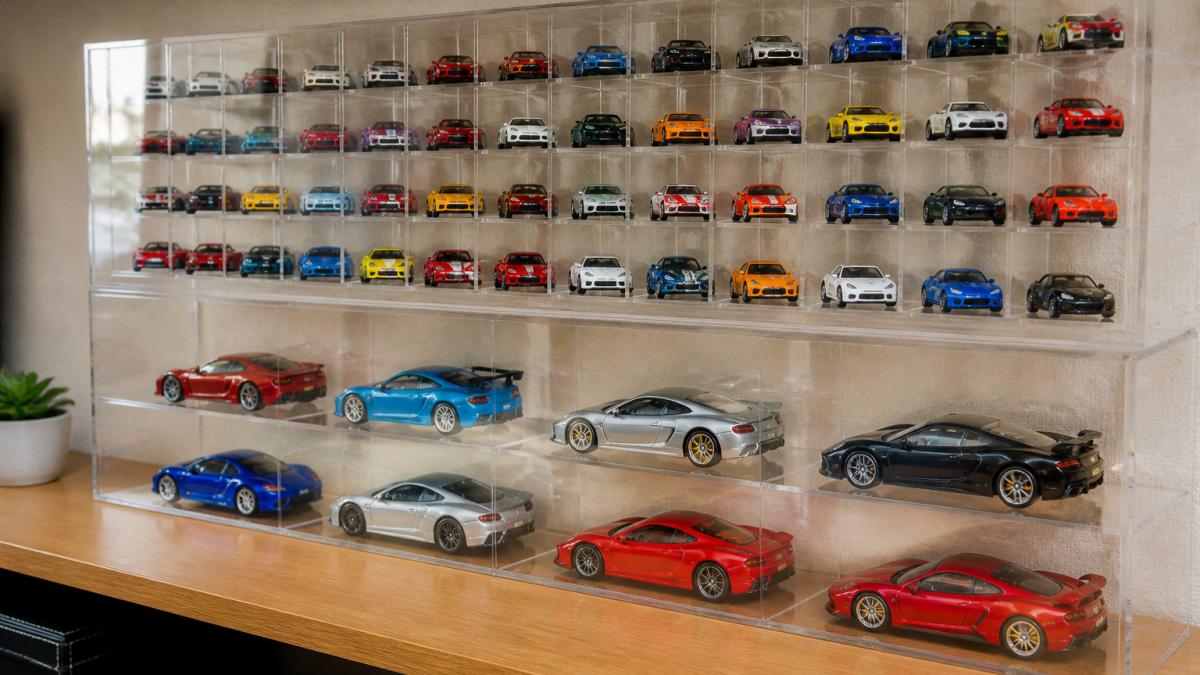
Acrylic vs. Glass: Material Comparison and Chemical Safety
This choice shapes everything about your display. Both materials work, but they solve different problems, and one carries a hidden risk most collectors ignore.
Acrylic display cases are lightweight, affordable, and easier to move and rearrange. Acrylic scratches over time, but it's durable for everyday handling. However, acrylic presents a critical chemical compatibility issue: standard acrylic contains plasticizers (chemicals that keep plastic flexible) that can migrate into your models' paint and rubber tires, causing permanent damage. This process, called plasticizer leaching, happens faster in warm environments and can turn vibrant paint dull or cause rubber tires to become sticky and deformed.
Not all acrylic is equal. Budget acrylic from discount retailers degrades faster and contains higher concentrations of problematic plasticizers. Museum-grade or archival acrylic, by contrast, is formulated to minimize off-gassing and is often labeled as "UV-stabilized" or "chemically inert." When shopping for acrylic cases, look for products that explicitly state they meet archival standards or are certified for long-term collectibles storage. Some manufacturers specify "plasticizer-free" formulations, these are your safest choice for valuable models.
Glass display cases offer superior clarity and don't off-gas chemicals. They look premium and protect better from dust and external contaminants. Glass is chemically inert, meaning it won't leach anything into your models. The downside is weight, cost, and the fact that glass shows every fingerprint and reflects light in ways that can obscure detail.
For serious collectors storing diecast models long-term, chemical compatibility is non-negotiable. A $200 rare Hot Wheels stored in the wrong acrylic case can lose $100+ in value from paint damage alone.
The practical choice: If you're displaying valuable models (anything you plan to resell or hold as an investment), use glass cases or explicitly archival-certified acrylic. If you're displaying newer acquisitions or lower-value models you handle frequently, standard acrylic works fine, just avoid leaving them in direct sunlight or warm environments where plasticizer migration accelerates.
Wall-Mounted and Shelf Solutions
Wall-mounted displays maximize space and create visual impact. Floating shelves work well for smaller collections and keep your diecast cars at eye level, reducing dust exposure compared to open shelving.
Key considerations:
- Weight capacity: Shelves must support the load. A single 1:18 scale model can weigh 2-4 pounds; a shelf holding 20 models needs to support 40-80 pounds safely. Always verify shelf weight ratings and use appropriate wall anchors.
- Sunlight exposure: Avoid direct sunlight on wall-mounted displays. Even north-facing windows expose cars to cumulative UV damage over months. If wall space near windows is your only option, use UV-filtering film on the window or install UV-blocking acrylic in front of the display.
- Dust accumulation: Dust still settles on open shelves. Plan to clean regularly (monthly for active display areas). Enclosed wall cabinets with glass doors protect significantly better than open shelves.
- Vibration and stability: Shelves near speakers, HVAC vents, or high-traffic areas experience vibration that can cause models to shift and fall. Choose stable, low-vibration locations.
For collections under 50 models, wall shelving works fine and looks attractive. Beyond that, consider enclosed cabinets or a dedicated display room with climate control. Enclosed wall cabinets (with glass or acrylic doors) offer the best balance of visibility and protection for larger collections.
Long-Term Diecast Storage Tips
Long-term storage is where serious collectors separate from casual ones. The goal is creating conditions where your models don't age.
Stackable Bins and Airtight Containers
Stackable bins let you organize large collections in small spaces. Airtight containers go further, they seal out moisture and dust completely.
The best approach uses both. Use airtight bins for your most valuable models. Use stackable bins for bulk storage of duplicate or lower-value cars.
What to avoid:
- Plastic bins that off-gas (cheap storage containers release chemicals)
- Stacking bins more than four high (pressure damages lower models)
- Sealing models in containers without airflow during humid seasons
Organization inside bins matters too.
Moisture Control and Climate Management
Moisture is silent damage. It causes rust on metal parts and promotes oxidation of paint. In humid climates, moisture inside sealed bins will destroy your collection.
UV Protection and Light Exposure
UV light fades paint permanently. A rare Hot Wheels left in sunlight for six months can lose 30% of its value just from color fading.
How to Organize Hot Wheels Collection
Organization isn't just about finding cars, it's about protecting them and tracking value.
Organizing by Scale and Series
The most practical system organizes by scale first, then by series within each scale.
Inventory Management and Valuation
Serious collectors track their collection like an asset portfolio. Create a simple spreadsheet with:
- Model name and series
- Scale and variant (different paint jobs count as different models)
- Purchase date and price
- Current estimated value
- Condition (mint, loose, carded)
- Storage location
This serves two purposes. First, it helps you avoid buying duplicates. Second, it documents your collection for insurance purposes.
Protecting Original Packaging and Condition
Original packaging adds significant value. A carded Hot Wheels in mint condition is worth 5-10 times more than the same model loose.
Preserving Blister Packs and Boxes
Blister packs are fragile. The plastic yellows over time. The cardboard creases under pressure.
Preventing Paint Damage and Oxidation
Paint damage happens through contact, moisture, and chemical exposure. Oxidation is rust developing on metal parts.
Common Storage Mistakes to Avoid
Most collectors damage their collections through simple oversights, not negligence.
| Storage Method | Best For | Protection Level | Space Required |
|---|---|---|---|
| Wall display cases | Active collectors | Medium | Minimal |
| Stackable bins | Large collections | Medium | Efficient |
| Airtight containers | Valuable models | High | Compact |
| Climate-controlled cabinet | Archive storage | Very high | Moderate |
| Open shelving | Casual display | Low | Minimal |
Frequently Asked Questions
Should I keep my diecast cars in their original packaging?
For collector-grade models, keeping original packaging preserves value significantly. Factory-sealed condition commands premium prices in the collector community. However, if you want to display or handle your cars regularly, removing them from blister packs is acceptable, just store the original packaging separately in archival sleeves. The key is protecting both the car and its box from dust, moisture, and UV damage. Many serious collectors maintain loose collections for display while storing sealed examples in climate-controlled storage.
What's the best way to store diecast cars long-term?
Use airtight, stackable bins stored in a climate-controlled environment with stable temperature and humidity levels. Place silica gel packets inside containers to manage moisture and prevent oxidation. Store bins away from direct sunlight to avoid UV damage to paint finishes. Keep the collection in a cool, dry space, basements with humidity fluctuations or attics with temperature swings can cause paint rash and plasticizer migration. Organize by scale (1:64, 1:18) and series to make inventory tracking easier. Check on your collection quarterly to monitor for any signs of deterioration.
How do I prevent paint damage and oxidation on stored diecast cars?
Paint rash and oxidation occur when moisture and temperature fluctuations expose metal surfaces. Minimize these risks by maintaining consistent humidity levels between 30-50% using silica gel or small dehumidifiers in storage areas. Avoid plastic bins with poor air circulation, airtight containers with moisture control are better. Keep cars out of direct sunlight, which causes UV damage to paint finishes. Store original packaging separately using protective sleeves to prevent chemical degradation from plasticizer migration. For valuable collector-grade models, consider archival storage methods with climate control.
Are plastic bins or wooden cabinets better for diecast storage?
Airtight plastic bins with moisture control are superior for long-term preservation because they seal out dust and humidity. However, the type of plastic matters, avoid PVC-based containers that can off-gas and cause plasticizer migration. Stackable bins optimize space and allow easy access to organized collections. Wooden cabinets work well for display but offer less protection from environmental fluctuations. For serious collectors, a combination works best: acrylic or glass display cases for active collections on shelves, and sealed plastic bins with silica gel for archive storage of sealed or valuable models.